
A Turn in the South


Unlike Delhi, Bombay turns on the charm from the moment we arrive. Well, several moments after we arrive, let’s say, and give us time to get past the taxi-wallahs circling like vultures for easy pickings. But when we find one who will actually use his meter, with the window down and the warm coastal air broadcasting the fruit stall, the fish market, the diesel and the incense, it’s good to be back.
Soon we are in Fort, the area where we are staying. We turn beside the red-brick heap of CST railway terminus, looking more like a cathedral than a train station, and we alight under the big palm trees in front of the GPO. It is easier to walk through the alleys of Fort than to drive. Our hotel, the Modern, is in the middle of the stationery and printing guilds, and there is a paper shop on the ground floor. We have really just come to Bombay for a break from the bleakness and cold of the north, and to eat. Most of the restaurants we know are in Colaba, and so after a small rest we set out on foot. There is constant throbbing activity in the narrow streets. A work crew in flip-flops is tearing up the pavement with pick-axe and shovel, and the porters hauling wooden carts loaded with boxes of computer paper, or carrying stacks of office furniture on their head jostle around the gaping holes. By the time we get to Horniman Circle the architecture is grand Victorian and Edwardian, but so many millions of lives have passed through the buildings that all Englishness has leached out, and it reminds me of the street dog I saw who
  obviously had some pedigree in his past, perhaps Springer Spaniel, but who now scratched his fleas like everybody else. Bombay is the beginning of the Indian South, and we go for Southern food – crispy dosas so long they don’t fit on your plate, and plump steamed idlies and their fried complements, vadas, served with a thin mild tomato curry called sambar and rich coconut chutney.
Usually we avoid the big tourist attractions. They are where the touts and the hassles are, and usually we have seen them already. But this feels like a holiday, and we buy tickets for the launch to Elephanta Is., an hour out into the port. Elephanta is the site of a huge cave temple, 1500 years old, filled with some of the most powerful and sublime sculpture found anywhere in India. It isn’t a natural cave, but a temple carved from the solid rock. Everything is meant to make the viewer feel small, from the guardian figures leaning on heavy maces to the forest of tall thick pillars receding into the dark interior. The centerpiece is the massive three-faced Shiva Trimurti, personifying the creator, the destroyer and the preserver, half-hidden in the shadows in the back. All the surrounding walls are also carved in highly-defined images from the Shiva story: Nataraja doing his famous cosmic dance; Ardhanari, half man, half woman, showing the unity of opposites; Shiva, his wife Parvati, and Nandi, his faithful bull; the violent, angry form of Shiva Tandava. Despite the echoing shouts of families on a picnic outing and the giggles of young men getting
 their pictures taken by cell phone in front of the Trimurti, the cave is brooding and evocative.
After 4 days in Bombay, we have an early morning train to Baroda, and leave our room at 5 a.m. It is no more than a hundred meters from the door of the Modern to the main street where we can catch a cab, but in the dark pre-dawn silence and chill we count 51 street-sleepers, tucked in doorways, prone on carts, all wrapped head to toe in eerie white sheets.
We are stopping in Baroda for one reason: our logo. The seductive little prince reclining so assuredly and luxuriously at the top of this page is the son of the Gaekwad of Baroda. ‘Gaekwad’ is a honorific meaning ruler, prince, king, and Baroda was the capital of the state he ruled. Now it is a city of over a million people, but it seems today we are the only whites – it is Christmas Eve, and Baroda is well off of any tourist trail. The palace is further than I anticipated, and when we finally get there it is closed. The gate is open and there is a watchman and a ticket taker, and we can see parts of the palace just down the drive, but we are forbidden from even taking a photo from a distance. Just one more of those crazy-making Indian moments.
 We have been in big Asian cities for the better part of 2 months, and I have read of a place near here, Champaner, a UN World Heritage site, that sounds like it might be nice and rural for a change. To get there, of course, involves the jam-packed rattle-trap buses I’m sure we have told you about before. Although it is only 60 km away, no one understands “Champaner”. I quickly figure out I have to ask for “Pavagadh”. They are both essentially the same place, but Champaner refers to the ruins of mosques no one but culture mavens and the UN cares about, whereas Pavagadh is a Kali temple on top of a big hill that draws worshippers from far and wide. There is even a cable car running up the mountain, but it has collapsed once already in 2003. Some of the old cars have found their way incorporated into tea shops in the village.
 The ruined mosques are from the 15th and 16th C, and are notable because of the strong Hindu elements found in them. Whether it is because the workers and craftsmen who made them were Hindu, and simply executed their commissions in the style they were familiar with; or
 whether the stones and pillars were harvested from existing temples, and modified to avoid any iconography; or whether the rulers were so far out in the Hindu hinterland, so far from the mainstream of Islamic convention that they were “going Native” – we were unable to find out. I like to think that it was the latter, and that, like the British after them, they sometimes went a little off the eccentric deep end, and were unable to keep the country and the culture from being absorbed into everything they did.
Huge walls and fortifications surround the base of the mountain. The bus stand and some tea shops clutter up across the moat, from where jeeps depart for Pavagadh Manchi, 5 km up the mountain, where our hotel is. Somehow we manage to squeeze into a jeep with our packs – not so easy, since they won’t leave until 16 people are aboard. More medieval gates and ruined walls are passed on the way up to where the cable car terminus is. A man is eating his lunch in the open back door of a van, unaware or unconcerned that a large langur monkey is on the roof directly above him. Beside them a donkey is eating a newspaper. Our room is in a state-run hotel, and although somewhat institutional, it has a balcony with a fabulous view over the plains.
All the bustle of Pavagadh is directed at the Kali temple, so when we go back down the mountain we are virtually alone poking around the  ruined mosques. Flocks of parrots fly screeching through the trees and minarets. The bounty of UNESCO is apparent in the handicap access ramps and watered grass of the main monuments, but not much overflow seems to have made it to the village of Champaner, squat and untidy within the huge fortifications of the citadel. We come in through a back gate, now overgrown with acacia, that once held out a Mogul army. A kid wearing only a dirty t-shirt stops dead in a lane when he sees us, and then hurries off to his doorstep and the protective folds of his mother’s sari. She gives us a dazzling smile. The main street is absurdly wide, given that water buffalo are virtually the only traffic that it sees, and we take a tea from a small shop and sit in the middle of the road and watch the village life unfold.
60 km from Champaner is the even smaller village of Jambugodha, reached by a bus that is even more crowded. After 20 km I get a cheek-hold on a seat with 3 others. A hundred years ago this area of western India was divided up into dozens of “Native States”, ruled by a Prince, Raja or Maharaja ( the British refused to call them “Kings”). Jambugodha was one such state, and the Maharaja’s hunting lodge has been converted, according to our guide book into a “simple and enchantingly peaceful” hotel. Not many guests arrive here on the local bus. Village women are selling vegetables and hunks of goat in the dust by the side of the road when we get off, and direct us out of town with a wave of the hand. With our packs on we walk and walk, and then turn onto a dirt road and walk some more. Katheryn is dehydrated and perhaps a little grumpy when we finally arrive at the “palace”. The reservation I made never made it to the staff, but the saving grace is that the current Prince himself, Yuvraj Karmaveersinh, comes out to greet us, assures us that a room is available, and wishes me a happy birthday.
Because it is a special occasion I am not concerned at the cost, but it is poor value for what we get. A tour group from Italy shows up later, and we meet a woman who is fed up with her tour, the hotel and pretty much all of India. “I have a dog”, she says, “and yes, she is very spoiled, but she would not go in the bathroom here!”
The trip from Jambugodha back to Baroda is notable for one thing: perhaps, in many years of crowded travel in crowded countries, I have  never been on anything this crowded. It is an Indian-made Tata jeep, and looks like it was designed from building blocks; there are no rounded lines on it at all. It is sitting in the shade of a tree when we reach the tarmac-ed road, and a re-organization immediately begins to fit us in. The packs, for a start, are placed loosely on the hood in front of the window, along with a sack of rice. We are wedged in the second row. In front are 6 people, the smallest sitting next to the driver with the stick-shift between her legs. People pile in, and on. At one point we are aware of 33 people traveling in this vehicle with seats for 12.
Even so, we make good time getting back to Baroda, and with several hours to go before our evening train to we decide to go try the Gaekwad’s palace once again. This time we have success.
Subscribing to the economic orthodoxy of the time, the Prince of Baroda decided to help his subjects through a particularly devastating famine by using the vast wealth he had collected from them in taxation to employ them to build him a sumptuous palace. Given that it was such a good cause, no expense was spared. He had marble imported from Italy, and crystal from Belgium. He modeled his fountains after Versaille, and his architecture from Mars. Some of the most  beautiful works, however, are the mosaics, done in an Indo-Byzantium-Romantic style executed in gold tiles. The most impressive mosaic of the lot is a larger-than-life tableau outside on the front wall.
The Gaekwad was only in his position of wealth and power by the grace of a single chance event, and this mosaic illustrates the story. His uncle was the ruler of the State of Baroda, and when he died the Gaekwad was on the dispossessed side of the family, making a living from farming. The ruler’s immediate heir, however, was old, childless, and according to the British agent a proper rogue, so a plan was concocted that would make it acceptable to the people to see the Gaekwad put on the throne. There was one condition: that the child his wife was pregnant with was a boy. The symbolism tells us that his wife, like Sati in the Ramayana, passed the test; the child was a boy (the prince of our logo) the farmer became ruler, and the British had an ally for the rest of their days.
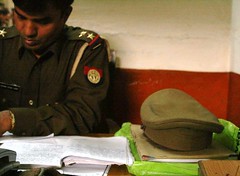 We apologize to our concerned and faithful readers for not keeping up to date with the blog. There are at least two reasons for this. One is that an unfortunate incident occurred on the train from Delhi to Varanasi back on Jan. 2. We had just boarded and were settling ourselves into our compartment, and chatting with the couple we were sharing it with. They had a 2-year-old who was doing an orangutan imitation, and a valise that was the size of a small car, and so in trying to move ourselves and our luggage in, we put a small shoulder bag on the top bunk. More commotion ensued, the conductor came, an empty neighbouring compartment became available, and in the process of moving our gear over we noticed that the shoulder bag on the top bunk was gone.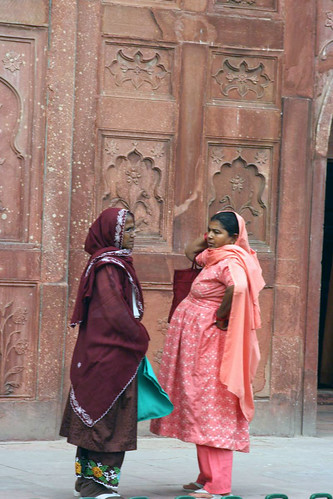
 bliss, since most of the year they endure +40 and dust, but we whine and pull on our down jackets. What Delhi has become for us is a production center. We make 3/4 of our bedding here now, dealing with Deepak, who has a small but modern factory with good light and new sewing machines, swatch books and numbered dye-lots. In the same neighbourhood is the husband and wife team of Parminder and Amrita. They know everything about scarves, and expose a lot of the myths that we have been fed from other less-reliable sources. Silk cotton viscose rayon and all the varieties of wool… there are some
  very good imitations and unscrupulous dealers out there. Within the environs of Delhi and the neighbouring Punjab is where much of the post-handloom production for these goods takes place, and Parminder personally oversees the patterns and fiber content of his scarves. One of the most beautiful things we find is a woolen shawl with Kashmiri embroidery. These are still made by hand in Kashmir, and they are amazing, and they cost a fortune. The ones we buy are Punjabi-made, and although the embroidery is done with a machine, it still is the result of the skill of the worker using the machine, and is hardly less impressive. An embroiderer makes 320 rupees/day, compared to the minimum wage of 150 rp, and it takes 2 1/2 days to do the most ornate shawls. A hand-embroidered shawl of the same complexity takes a month. We also find some fun things, like the classic Delhi carry-all, the recycled
 advertising bag. These were originally made to promote everything from toothpaste to Bollywood blockbusters, and are the everyman’s bag in this city.
 work for our wall hangings. Then we found Kishor, in Jaipur. Kishor’s family is from Sindh, in southern Pakistan, and was displaced during the disaster of partition in 1947. His grandfather was in the textile business, and they moved to Barmer, across the border in Rajasthan. We also went to Barmer, hearing that it was where much of the embroidery comes from. It turns out that this is like going to Saskatchewan to buy bread because that is where wheat comes from. The embroidery certainly passes through Barmer, some of it local, some from Gujarat, and much, now, from Pakistan. But it
  filters through all the villages, and very little can be found in any one place. Dealers like Kishor and his father buy it from many sources, and then are able to amass a reasonably good selection. Once again, the rapidly changing times in India are evident: much of the best Indian tribal work is getting harder to come by, and is being replaced by characterless modern embroidery. The best stuff now comes from Pakistan, from Sindh and Baluchistan, and we find some wonderful pieces at Kishor’s.
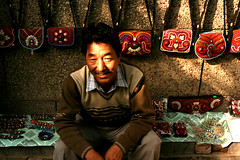 separate shipment, and the costs multiply accordingly. If we come across a local artisan producing treasure, we have to carry it out with us in our luggage. Sometimes we just can’t pass it up, as with Topkay, the Tibetan gentleman who sits at the corner of our alley everyday beading bags. Fortunately, Parminder agreed to do us a favour and include Topkay’s bags in his shipment (for a price, but that was reasonable), and we put
  in a sizable order with him. Topkay has been at his corner everyday we have been here, but the day after we payed him he wasn’t. I hope that with the little windfall we gave him, Topkay took a holiday.
 live at Scindia ghat, which is to the east of center. In front of our window is the leaning tower of a temple too heavy for its foundation, now picturesquely subsiding into the river. From our hotel we walk down a dark flight of steps, and as soon as we set foot on the ghats above the temple someone yells “Hello! Boat?!” It is a greeting we will hear several dozen times a day, touts trying to take us for a ride on the river. A few steps along and we are at the wood piles of Manikarnika Ghat. This is the most auspicious – and expensive – place to be cremated. Big scales weigh up the logs for each fire. We take an archway to the left, and descend almost into the yard where the bodies are burned. There are always five or six pyres on the go. I have seen this scene many hundreds of times, as have most people
  here, and there is very little overwrought emotion on display. All the same it is a peculiar place. Dogs find relief from the cold and their itches by curling up in the warm embers, and sometimes a naked holy man will bathe in the ashes of a dead fire, covering himself from head to toe as a graphic expression of the impremanence of life. We skirt the top of the burning grounds, and return to the river’s edge under the palace where our friend Pappu lives with his family. The palace has been abandonned and unkept for generations, and Pappu, a kind but down-at-the-heel Brahmin I met years ago has as squat inside. Charming as they are, the ghats are filthy and smelly, serving as a toilet for dogs, people, cows, water buffalo, and all the other creatures who have nowhere else to go. A little way along the ghat is wide enough to play cricket on, but I always wonder: who gets to fetch and clean the ball, or do they just keep bowling crap?
 but primarily it is a big laundromat. The water is a turgid brown, and knowing what goes into it I recoil from even getting my sandals wet, but scores, hundreds, thousands of people are scrubbing frothy masses of clothing in the river, and while their knickers are drying they brush their teeth and lather up and kick around for a bit of a swim. Either the hospitals are filled with ulcerous cholera patients, or there is a God.
 our business, we decide to keep going. Right beside the main ghat, the Dharbhanga and the Maharana have some beautiful palaces, but from there things decend out of the tourist-pretty very quickly. The Harischandra ghat and it’s environs look more like the water buffalo bathing ghat. This is another cremation ground, however, the poor relative of the Manikarnika. There is no fancy temple here, just a mud flat where the bodies are washed and burned surrounded by wallowing livestock. Beside it, the Dandi Ghat has attracted some pretty strange tenants. There are holy men, sadhus, all over the city, and dreadlocks, ashes, face-paint, robes or lack of them, pet snakes, drums, skewered lips, hash-filled chillus don’t usually attract my attention, especially as there is often a pitch for money involved. So walking by the makeshift tent I barely glance in, but Katheryn says: they’ve got a human skull!. I know it’s bad manners, and I don’t usually take pictures of people with human skulls
  without asking, but this time I sneak one, and get out of there quick. This is India, and there are no solitary occurances, and a few yards on the sadhus have FOUR skulls on a mat in front of them. This time I ask for a photo, and the answer is no.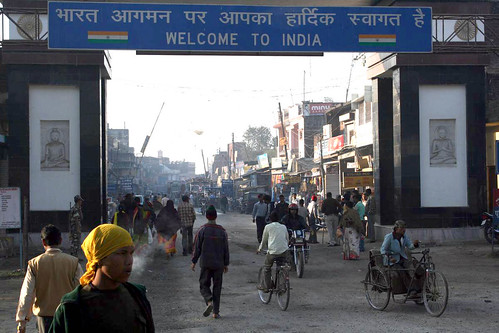
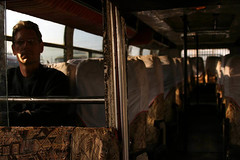
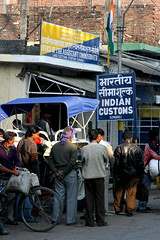
 We turn off the highway and find ourselves on an elevated, single lane brick track, more like a drainage dyke than a road, running through the countryside. With rice paddies on each side we bump along in a cloud of dust about 10 feet above the fields. Ironically, the bricks in the road we are following are yellow.


 I am 27,000 ft above the plains of northern India. They couldn’t be flatter. Big rivers meander across them like fat pythons, leaving tracks of sandbars and abandonned ox-bow curves. I can see villages stretched along the banks, and everywhere the geometry of fields. The only places where there aren’t any signs of human impact are the flood plains themselves, reluctantly left alone because of the power of the monsoon. Earlier this year the floods hit hard; the rivers broke their banks and milions of people were displaced.
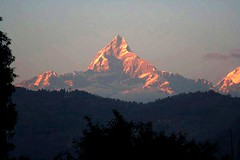 Langtang; Everest. Or is that one Everest? Well, it could be- it’s big, white, and in the Himalayas…
 Kathmandu’s airport is rapidly becoming engulfed by the sprawl of the city, and it looks like we are going to touch down amid the flat-roofed three story concrete buildings as we approach the runway.
 Kishan supervises the operation. In the winter there might be ten men working here. Now there are only two – the rest are back home for the harvest and the festival. They are paid by the piece, and make $200 to $300 /month, about the same as a teacher in the village, and are provided with room and board.
 worried. It’s enough, in fact, to make him consider leaving Kathmandu and the business his father established a generation ago. Malik is 55, although with his black hair, smooth skin and perfect teeth he could be 20 years younger. Like most Nepali he views life with acceptance and good humour. He has worked hard to provide an education for his three children, and owns his own home, which he is very proud to take us to. He doesn’t have a car, but in a small city with chronic petrol shortages, he doesn’t consider this a big concern. Malik is determined to provided us with that essential of Tibetan hospitality, yak-butter tea. Several times on the way to his place he asks if we have tried it, as if breaking us in for something. In fact the last time I had it was more than 20 years ago. It was in a shepherd’s hut high in the Himalayas, and the concoction of fermented butter, hot water and salt was so nauseating I haven’t been tempted since. Malik assures me this isn’t the same – it’s made from a package. Malik’s wife greets us, and we are made at home in the family room while she prepares the tea. I think other foreigners have tried and failed this test, as there is a hovering expectancy, a compulsion to preform this ritual even though disappointment is inevitable, as the tea is brought in. It is white and frothy, but doesn’t reek of rancid socks – my visceral memory from the last time. I raise the glass. Silence, tension. I try it. Mmm, that’s good! The relief is palpable. It tastes a bit like salty chicken soup stock, and although I wont, say, switch from coffee any time soon, my reaction was not just being polite. Encouraged by their small success, the next thing to come out are the homemade butter biscuits. No problem there, and even Katheryn, who had not made much headway with her tea beyond smiling at it, is enthusiastic. Now Malik seems prepared to take a gamble. He prefaces it with the story of his wife’s last trip to Lhasa to see her mother. She had brought back something very special, a delicacy you couldn’t get here. Raw dried yak. Sure, I said, is it smoked? No, only dried. Cured with salt? No. Tibet is very dry. And cold. OK, maybe a small piece…
 the area of Kathmandu where we live, is a chaotic few blocks of shops, guest houses and restaurants. One of our favorites is a little Tibetan place tucked back behind a row of shops called Gurung. It has the best tongba in town. Almost always there are locals sitting around in the dim light, on their tables flagons with metal straws sticking out of them, and a thermos of boiling water. In the flagons are a couple of cups of fermented millet, like coarse dark sand. Hot water from the thermos is poured on top, and after a few minutes it turns milky. The metal straw is pinched and perforated at one end, so that none of the grain mixture is imbibed when you take a sip. Tongba has a slightly sour, saki-ish taste, but is very mild. Hot water is continually added into the flagon, and after a litre or more, when the flavour starts to diminish, it feels much the same as having drank a beer. But on those cold Kathmandu evenings there is nothing like it.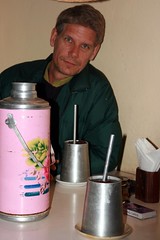
 view. The fish tail mountain is sacred, and never been summited. Mountaineers can only go within 100 meters of the top. Annapurna II and IV, David guesses, are the two other big boys in our back yard, and measure in at around the 8000 meter mark. We arrived by rather luxurious bus yesterday. Having upped our budget by 50% we can splash out on the $15 ticket. Lots of leg room, decent lunch provided, no music, didn’t take on passengers or let others alight mid-trip – and no chickens, sacks of onions or bundles of steel pipe underfoot.
 Drying corncobs give a picturesque detail along the glassless window frames. Beautiful as it looks, this is tough living. People eke a livelihood from two-foot-wide rice terrraces carved 1000 feet up the slope, and water has to be carried long distances from gravity fed water taps sticking out of the trees. It would be a real struggle to provide one’s basic needs.
 launch from, and it provides stunning views all around. We stop at a small shop for breakfast, and have tea with an incredible vista of Machchapuchare and the Annapurnas. I don’t see the need to go the remaining few hundred metres to the top of the hill, but David is keen, so I sit in the sun and talk with the owner. She has problems. During the monsoon in August, a landslide took out the slope in front of us. Then another one directly behind took away her buffalo paddock. There isn’t much land left on the razor’s edge we sit on, which represents her life savings. To stabilize the slope with concrete she estimates will take a year’s income, and even then nothing is gauranteed. She says that there has never been a monsoon as severe as this last one, and is willing to take her chances. It seems to me, though, that she is another casualty of the bigger climate disaster we see everywhere, and more severe conditions are what we can expect.
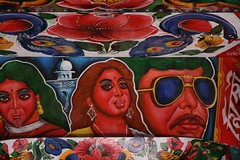 We left the shady streets by Rambutri Wat,Banglaphu, on the mini bus for the airport at 2 pm. We have a flight to Kathmandu thru Dhaka on GMG airlines, which will require an over night stay in Bangladesh. After last year we decided we preferred this over flying to Calcutta and going overland thru Bihar to Birganj. We all remember what happened in Birganj last time? (check ‘Escape from Birganj’ in the
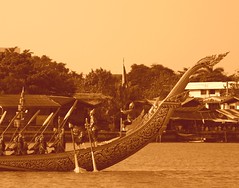 The commemorative procession of royal barges was to start at 3:30 on the Chao Phraya River. Tickets for the grandstands were being sold for 800B, but we could view at a nearby park for free. I got a front-row spot by the rail by 3:00, and held it while David sat out of the sun as he didn’t have a hat on and I did. This centuries- old tradition of very long decorated barges takes place only periodically, this being the 16th time in the last 60 years.
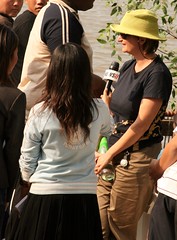 and the host asked if I was willing to be interviewed for the evening broadcast. Naturally I complied, although I hope that the viewers will be mesmerized by my wit and wardrobe, since I hadn’t done much homework on the reasons for the ceremony, which is what she was asking me about.
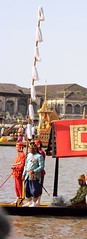 decorated staves on the wooden deck could be heard. It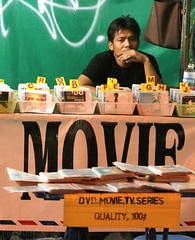
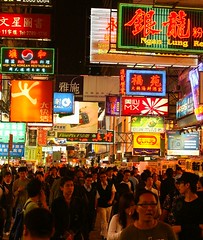 Hong Kong 10 years on.
 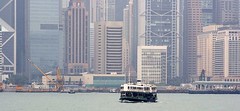 Star ferry to all the various theatres around the city then promptly flew to Canada for 2 weeks. On my own in Hong Kong I found the place completely perplexing. It was a not stop construction zone, so many jack hammers I wore ear plugs walking outside. The crowds were so intense you frequently felt someone’s shoe under your heal before you lifted your toe to take a step. There was tremendous difficulties ensuring the food I was ordering would be what I wanted. The pollution made my eyes red and puffy. It was also, in an historical footnote, where I took the by-line “Foreign Devil Correspondent”.
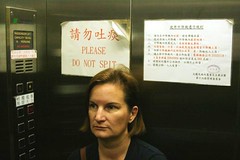 Lifts stops at ever other floor, odds or evens. People queue for the appropriate lift, which is tiny and often one opts to take a lift to a floor higher and walk down. A ‘car full’ sign lights up on the descending car to pre-warn that the door will not open at that floor. I heard that on Hong Kong Island there is not enough square footage for everyone to stand outside at the same time, since so much of the population is stacked up into the skyscrapers.
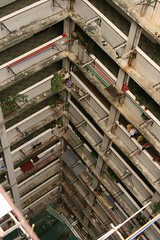 measured 7×8 feet. The bed took half the space, the bathroom another quarter. We had to keep one pack under the bed and only one person at a time could stand in the remaining space. It was $31(HK$250)/ night, or about 50 cents/sq.ft.
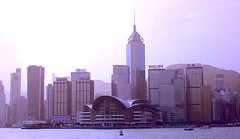 Rain greeted our arrival, and socked-in dense clouds ruined our skyline photo opportunities. Socklessness was fine but my t-shirt warm wasn’t enough. After a day and a half of our planned 3 day visit we found the Cathy office and bumped our departure up one day. We were burning through $75/day and definitely not living large. That kind of cash in Bangkok would get you luxury, so off we went.