
ENTER THE EARTH OX

 Another arrival in Bangkok, and another new Prime Minister in Thailand. It’s getting repetitive. This time the new leader is Abhisit, and the difference is that he is from the side of the yellow shirts with the hand-clappers. These are the people who blockaded the airports in Nov., and his selection should mean an end to paralyzing protests in Bangkok. Now it is the Red Shirt party with the foot-clappers who are disgruntled and it remains to be seen what kind of pressure and disruptive tactics they will be able to exercise.
It’s always a relief to be back in Bangkok, but our unfinished business from India continues to dog  us. I didn’t want to leave India before our orders were completed, and packed, and sent, but the assurances we received from our suppliers have repeatedly turned out to be misleading, and things are starting to fall far behind schedule. The astrologers promise all that will change. We are on the cusp of leaving the fiery Rat Year, in which things are bound to go haywire, and enter into the stable, if un-dramatic, Year of the Earth Ox.
The place to be for Chinese New Year in Bangkok is Yaorawat Road. Yaorawat is a blaze of neon signs advertising its two famous businesses: restaurants which serve badly, badly incorrect food such as sharks’ fins and bird nests; and gold dealers. I expected it to be busier. Even the shrines and temples on Yaorawat and in the surrounding alleys are conspicuously quiet. Partly this is bad timing: it is mid-afternoon the day before the biggest celebration; and partly
  it’s the economy. Many businesses are doing poorly, and the price of gold is so volatile that for the first time ever, on the Sunday that the markets are closed and the merchants can’t get minute by minute updates, the gold shops shut their doors. Despite this, it is colourful and crowded, and strings of fireworks are going off, and in a striking parody of the world-wide government rescue plans for the economy, piles of worthless paper money are being burned on the street.
Back down in the tourist-ghetto of Khao San Rd., three elephants and a troupe of lion dancers are competing for the attention of a small forest of photographic equipment. The announcer for the elephants is trying to generate excitement: ”This is the first time three elephants have ever appeared together on Khao San Rd.!” he shouts, and the elephants, giving the people what they
  want, stand on their hind legs. Even so, they are getting stiff resistance from the dancers, who have drums, fireworks, lions, and a spectacular 10-man dragon who solicits donations in its jaws from the shop keepers. I position myself for the real event: when the dragon entourage meets the elephants, who, freaked out by the noise, will charge wild-eyed into the sea of spaghetti-strap tops and zoom lenses. Fortunately (I guess) , when the fateful moment occurs the elephants remain aloof and detached, putting it all down to just another day of degrading work for The Man. And what do they get for it? Just peanuts

LAOS: SLOWLY UP AND DOWN THE MEKHONG
Laos is a wonderful country; so far I’ve only met one person who didn’t like it, and he was Austrian, and bitter. Usually we justify a few weeks here by traveling up to Luang Prabang, and  buying as many hand-woven scarves as we can carry from our friend Sukhsavanh. Laos is entirely landlocked, with a long, relatively-skinny neck in the south supporting a star-burst head in the north that reminds Katheryn of the profile of Side-Show Bob. The star-burst head part has the topography of a crumpled ball of paper, and is stunningly beautiful. The long neck follows the wide vein of the Mekhong River, with the eastern border being a spine of mountains separating Laos from Vietnam. In previous trips we have crossed through Savanakhet and Lak Xao in the middle of the neck, coming and going from Vietnam, but we have never been in the far south.
A 5:45 am train from Bangkok gets us effortlessly to Ubon in eastern Thailand by 2:30 pm. The plan is to do it the easy way, and take the last “Friendship Bus” of the day at 3:30 straight to Pakse, Laos, in time for a cold sunset Beer Lao on the Mekhong. Within moments of leaving Ubon station, the plan has gone awry. I am expecting some motorcycle-based form of taxi to take us the ten km to the appropriate bus station. Instead a lanky cowboy solicits us, and agrees (too readily) on a good price and hustles us out to his pick-up. A few minutes later we are at a place where transportation leaves from, but it is definitely not the station I had clearly insisted on. Its a songtaew stand, home of the very-local pickups with two wooden benches in the back for passengers. There is a lot of commotion, and negotiating, some recriminations, and finally we accept that resistance is futile, and we are crammed into the back of a songtaew heading to some place half way to the Laos border. There we are met by a larger, rougher vehicle doing the next 40 km to the frontier at Chong Mek. This is a 5-ton truck with wooden benches, and its
  excruciatingly slow. Still, the locals are friendly, and school kids are riding on the roof, and eventually it get us close enough that we can walk the rest of the way to Laos. As it turns out the “Friendship Bus” and its load of much smarter travelers then us arrive just as we check through immigration, and I am able to slip the driver a few baht to take us the last 40 km into Pakse.
Pakse has the last reliable and affordable communication with the rest of the world that we will have for some time to come, and we have to stay a couple extra days making phone calls to India and sending off emails done in caps lock titled URGENT RESPOND IMMEDIATELY or some such variation of attention grabber. When we are satisfied our goods have been set in motion we head south to Champasak, a small town 30 km away on the other (west) bank of the Mekhong.
Back in the time when huge snake-kings ruled in under water realms below the river, a prominent natural rock formation on top of a mountain here was believed to be the linga (penis) of the god Shiva. Even before the Khmers to the south were building Angkor Wat, Champasak was the capital of a powerful Hindu kingdom. Nothing is left of it now except for one extraordinary temple, now a ruin, from  the 10th C.
Lovely hand-built ferries ply back and forth across the river. The smaller ones take motorcycles and passengers, and the largest, like the one our songtaew is on, can hold around 6 vehicles. Boarding and landing is done straight from the beach, with a couple of heavy planks the only help for drivers on the sandy slope. The modern village of Champasak, 8 km from the temple, is a charming little place. Almost everything is spread along one paved road beside the Mekhong; whatever didn’t  make it there is on a parallel dirt street. At the center of town is a forlorn fountain, which hasn’t worked for decades, the project of a governor whose grand mansion was also never finished, and is now a sprawling ruin on the dirt street a block away. Maybe this is where ambition goes to die, but it certainly doesn’t bother the owner of the Vong Paseud guest house, where our songtaew drops us. His contagious good nature earns him the nickname ”Mr. Smiley” and his open-air restaurant right over the river is the ideal place to relax with a Beer Lao in the evening. We hire bicycles and take a spin around town in the afternoon. There are a couple of old French mansions, and a pretty wat, and not much else, but people always wave and smile and shout Sabai Dee! (Hello. Lit: Its going Good!).
 The next morning we take the bikes along the flat river valley towards the ruined temple and the sacred mountain. It’s a quiet, beautiful ride to a quiet, beautiful site. The temples architecture and lay-out reflected the cosmic order, and its alignment is on a axis from the rising solstice sun towards the sacred knob on Phu Khuai (Penis Mountain). A magnificent avenue of large frangipani trees lead us up a stone stair to the main temple. The sanctum was converted to
  Buddhism centuries ago, and the current trio of bland-faced Buddhas inside are out of place next to the spectacular 10th C. carvings on the lintels and on the front of the structure. More unusual, and more beautiful, is a rock-cut trio of Brahma, Vishnu, and Maha Shiva on a boulder nearby. This four-faced icon represents Shiva as the ultimate, eternal creative and destructive
  demi-urge, but I cant help seeing a likeness of John Lennon in the face on the right. Close by is another mysterious figure: a life-size crocodile carved deeply into a rock. Local guides will tell you this was where human sacrifices took place. The crocodile, however, is also the vehicle of the goddess Ganga, and since according to its
  metaphysical geography the Ganges river is channelled here this would be a more probable explanation.
From Champasak our journey continues down the Mekhong to the most southerly point in Laos, called Si Pan Don, The 4000 Islands. Here the river braids into innumerable channels and courses, growing to a width of 13 km. It also plunges down into Cambodia in a long series of cascades and falls, the only major navigational obstacle on the Mekhong between China and the delta in Vietnam. When the French were in control they envisioned a railway to bridge the gap, but they didn’t get much farther than a short bridge between two of the  principle islands Don Det and Don Kon, and a couple of locomotives now rusting on Don Kon.
At one time, maybe 5 years ago, Det and Kon were oases on the back-packer trail. There was no electricity, and accommodation was in a scattering of palm and bamboo huts on the waters edge. When we arrive on Det, after our low-key small towns and ad hoc transport, it feels a bit like Martin Sheen getting to the American’s R + R base in Apocalypse Now. All of a sudden there are  hundreds of tourists, from the didgeridoo crowd to the Tilleys hats with rolling luggage to the very drunk Thais disgorged from their garish air-brushed mega-buses. We disembark from our boat on the northern tip of Don Det, where most of the development is, and I leave K in a restaurant with our bags while I look for somewhere to stay. The options are so close together and unappealing that I am almost all the way to Don Kon before I even ask to see a room. Things are so far below the minimal standards for security, comfort, privacy and value that we are used to that I end up getting a bicycle, and going across the old French railway bridge to Don Kon. There, at the very last place,
  is a room that is less than a disaster, and I take it. We can still hear neighbours zipping luggage next door, and they might as well be using our bathroom when they use their own. But there is a deck overlooking the river, and with a cold Beer Lao open, K tries to assure me it’s not so bad. And in fact, when I do manage to look around, the place is frighteningly beautiful. It’s much greener and
  more tropical than anywhere else we have been in Laos, with huge tamarind trees hanging over the water, and palms lining the dirt paths by thatched houses. There is still no electricity, but everybody has a generator, and during the designated power hours of 6 to 11 pm, the thumping is incessant . Still, the beauty is enough to keep us on Don Kon for another day, where we
  take bicycles to one set of the famous Mekhong cataracts, and further onto a quiet beach where we could literally swim to Cambodia.
Our last destination in the 4000 Islands is the largest of them, Don Khong. As soon as we leave Don Det the transformation is almost magical: all of a sudden we are sitting with locals again in the back of an old truck; and on Don Khong everybody is still interested in everybody else, and all say Hi and Sabai Dee to each other.
I have to be honest: we came to Laos looking for a lovely place to  stay, in a beautiful spot where we could put up our feet and relax. No hard travel to the ends of the earth; no great discoveries unsullied by a Western face; no gut-wrenching moments you can laugh about later. Champasak and Don Khong were very pleasant, but still not exactly the ticket. Don Det and Don Kon could have been, but are now, sadly, finished. There is only one more place to try, one more blip on our radar.
TAT LO: SOMEWHERE UNDER THE WATERFALL
To get to Tat Lo we have to go back to Pakse and head east from there. Although not the most  interesting town in Laos, at least Pakse offers a bit more culinary variety than we have enjoyed in our southern swing. Being veg doesn’t help, but whereas anywhere we go in Thailand we can find delicious food, in small-town Laos it has been pretty dismal. It also seems to be an article of faith that people with white skin don’t eat chillis. Even when we say, in Lao, “I like it spicy”, the standard response is “Not spicy!” and it arrives bland. And since ”vegetable” generally means “cabbage” we’ve had a lot of disappointing meals.
Our transport from Pakse to Tat Lo is a real bus, with doors and seats. And a video. As usual, the DVD that is popped in is Thai karaoke, and pretty young actors and the boy band of the moment play out tales of heartbreak while the little bean jumps across the words on the bottom of the screen. It’s saccharine and formulaic, but for rolling through Laos villages on a local bus it’s not a bad sound track. Besides us and the Laos, there are three young Australian back-packers on the bus, with the dread-locks, the djembe, the guitar, the talismans around the neck - badges of a counter-culture even I missed out on travelling in Asia 25 years ago. Thai pop is not their thing, and one comes to the front to offer one of his CD’s to be put on. Before we know it, we are surrounded by droning Hindu devotional chanting. The general reaction, from the bus driver to the wizened 80-year-old granny with gaping betel-stained gums, is to turn around and get a better look at the Aussies, and start laughing. The conductor good-naturedly puts up with 10 minutes of the names of Shiva, and puts the karaoke back on. The Aussie makes his way up with another CD. This time it is Bob Marley- a better choice - but the CD
  skips, and the conductor isn’t going to try to make it work. The karaoke comes back on. The Aussies sense defeat, and sullenly plunk away on the djembe in the back.
It is fairly short ride in a samlor a three-wheeled version of a songtaew from where the bus drops us to the village of Tat Lo, along a dirt road. First impressions are certainly positive: we cross a long wooden bridge below the multiple streams of a cascading falls. A handful of guest houses have been built around the falls and along the river, next to a pretty little village where cows account for most of the traffic, and almost all the houses are traditional teak-on-stilts architecture with photogenic stacks of wood for cooking beneath them. After a bit of a search, we find the hut we are looking for. The walls and floor are made of hand-cut teak planks, roughly joined, and the roof is thick stacks of thatched teak
  leaves. Perhaps the best thing about it is the setting: at the top of the gardens at the Sayse Guest House. The restaurant of the Sayse is in a prime position at the base of the waterfall, set in lush and beautifully-landscaped gardens. We walk up to our rustic hut on a stone path under sweet-smelling jasmine, climbing Dieffenbachia vines, flowering bananas, and a host of other tropicals.
Almost everyone, local and foreign, swim in the pools above the first falls. I guess that’s as far as most people get. We explore a little further and come to a second falls. A very rough track descends to the pools at the bottom, and the entire time we are in Tat Lo - 4 days – no one else (except for a few kids the last day) makes it to this beautiful spot but us.
Your Foreign Devil Correspondent
As usual, only a few of our photos are included in the blog. Sit back, open a Beer Lao, go to https://www.kebeandfast.com, click EXPLORE choose a set ( Tat Lo, 4000 Islands and Chinese New Year for this blog), and find the slideshow button. We’ll take you there.
 Back in Jaipur we are relieved that the cold wave which is killing people across North India hasn’t settled in here too harshly. The days are clear and sunny, around 20C, and at night it goes down to a bearable 8 or 9. Contrasting this to your reports from Canada – minus 50 with the wind in Winnipeg; too much snow
  to drive on the upper levels in Vancouver – I guess we shouldn’t complain.
 days and get the shipment on its way – but this doesn’t inspire confidence.
  produced. Now we are able to make a trip to the village of Bagru, where another style of printing, which our merchant calls “Bhooti” comes from.


 Growth has been so fast in Gurgoan that no one knows how many people are here, whether it’s 2 million or 10 million, only that the population has so far out-paced infrastructure and resources that even the model high-rises that are everywhere get only two hours of water per day, and 60% of electricity is pirated from the wires. In Noida farmers have made big money from selling to property developers, but the urban/rural divide is still stark. This last week a girl was sitting with her boyfriend parked at the side of the highway, when she was attacked and gang-raped by thirteen locals. The first reporters to the village encountered some extraordinary attitudes, including the head man saying: what’s the big deal; it was only a rape; and the grandmother of one of the accused: they shouldn’t have had a chance to rape her; she was acting indecently and should have been stoned, first.
 The trip to Varanasi is uneventful, and there we have two tasks. The first is checking up on another of our orders, which is (deja vu) supposed to be ready to go. We always like to visit Ajit, but this time he has neglected to finish some of the seams inside his duvet covers. This will take another ten days.
 here. We find a nice cast-bronze figure in the market, and Katheryn decides it will add significance if it is blessed at one of the shrines . There are three that I know of on the way down to the Manikarnika Ghat, the famous open-air cremation site on the banks of the Ganges. The first one is managed by a guy we have known for years. He is also a fairly heavy user of a certain sacramental herb favoured by Shiva, and is apparently unavailable somewhere in the back.
 and have a row on the Ganges.
 with the guy on the end of the line telling him the train which left ½ hr. ago isn’t there yet. But this doesn’t help us, not even with getting a refund. The rules state that if you miss your train, you can get a 50% refund within the first three hours. It seems self-evident to everyone we talk to that a) the train has been missed and b) the refund will be 50%.
  exhausted brain has a good idea: we can change our Bangkok flights! With some of the pressure off, I go in for my interview with the Big Boss. He is sympathetic, but about a full refund he spreads his hands. “Even I” he says, “can do nothing.” He also assures me he will pull some strings, and get us berths on an otherwise-full train this afternoon.

 Palitana makes a convenient stop-over on the way back to Ahmedabad, but it also a well known Jain pilgrimage site.
 basically a simple palaquin carried by two porters up the hill. The dhoolie guys are especially persistent, and keep soliciting as we climb. The staircase is broad and even and packed with people even though it isn’t a special festival or holiday. There are many families, obviously city raised, with digital video cameras and designer sunglasses, but there are also barefoot pilgrims clad in white cotton. There are no other foreigners. For the most part we keep our heads down and trudge, like everybody else. The descending dhoolies shout at you to make way, and a surprising number of young men and women are running down the stairs.
  might not be the original stair – this hill had temples two thousand years ago – but when we leave the commotion of the main trail to follow it we enter a different time.
 idol is meaningless for me, and K. and I climb up the temple as far as we can get to get a view.
 crowds are far thinner. From here, after scampering up to the top of more temples, we get even better views. Going down we fall into step with a young man, Mukesh, accompanying his friend. Mukesh is fascinated that two people from a distant country would be on the Palitana hill. He is genuinely happy for us, that we would get the blessings for making the pilgrimage to the top. His friend, however, is on a much more serious quest. According to their beliefs, if the hill is climbed seven times in two days, without taking food or drinking water,
 7:30pm and our round trip took three hours. That is why people are running down. That is why there are numerous white robed devotees, barely able to walk, supported on the shoulders of friends and family. For Mukesh’s friend, this is the last descent, and although he is obviously exhausted, he is doing well. It wouldn’t be hard to die of heat stroke undertaking such a grueling challenge and we have seen a number of people lying on the ground in obvious distress. After just one climb, our legs are screaming for days. It seems impossible to me that someone could do this seven times – that is 49,000 steps! But then the important thing, for more than physical conditioning, is to have faith.
 hunting retreat converted into a hotel. We tried, but there was no room at the palace, so we had to settle for the seriously down-market option of a $10 place in town. Being New Year’s Eve,
 crumbing battlements. Chittor is impressive for its size – it is built on a flat top hill and the area enclosed by its walls is 28 sq. km. Inside there are the obligatory atmospheric and photogenic ruined temples and palaces. What it is most famous for, however, is the unaccountable fact that it was taken in battle so frequently, and the resulting “jauhar”. In the Rajasthan of the middle ages, losing a battle didn’t merely mean raising a white flag and surrendering. When all hope seemed lost,
 nearly everyone lived inside the city walls, and he talks about growing up here with understandable nostalgia. In general I hate being saddled with any sort of guide, but Kailash does a good job of staying out of the way as we clamber about ruined and rebuilt temples, palaces and battlements. The most famous monument
  in Chittor is the Jayastambha a
 the great road up, once contested by the troops of the Mogul Emperor and suicidal Rajput warriors is now a rough track used by village women.
 quirky, like the Andamans, but not as distant.
 Diu one day at a time, by bus.
 recommended by our friend Peter who was just there – and it is quite lovely.
 station, Roger Moore’s rocket-propelled auto-rickshaw ride through town doesn’t seem too far from the truth.
 main drag is the totally-inappropriately named Relief Rd, and our hotel is just off it. The last time we were here our room actually rattled due to the traffic. Now we have gone a little more upscale, and it is worth it. Since we are in the textile business, and since our hotel is alright, we decide to see if there is anything in this town we might be interested in. Ahm’bad, after all, is the capital of the state where much of our tribal embroidery comes from. We visit a night market and find a lot of cheap-quality knock-offs, but also some old and/or good pieces. The prices start out astronomically high, but competition is so keen that they quickly come down to absurdly cheap. I’m not interested in doing business this way, and no one, of course, has any of the commercial
  licenses necessary for exporting, so K buys a couple of blouses and we leave.
 highway in rooms that were once (on one wing) for the palace guard, and (on the other) their horses. As we wander through the streets we stumble on a square of grand four-story buildings – the tallest in town – that look like they belong in Whitehall, but which are now encroached upon by tailors and mechanics – and even for them the upper stories are too run down to use. People aren’t used to foreign faces here, and everywhere we are greeted by smiles and kids calling out their text-book English phrases. K makes the observation that a group of sari-clad young women who giggle and say “Hi!” are black, with frizzy hair. Soon we are seeing local “blacks” everywhere. When we are back in our room I do a Google search (in case that went by so quickly that you missed it – for the first time in all our travels we have wifi in our room. In Junagadh! Our swish hotel is actually a christmas present from Marianne – Thanks again! ) and discover that many blacks came to this part of India from Ethiopia and East Africa to work in some capacity for the Maharajahs. They are called Sidis, and now dress and talk like the locals, although even after 200 years inter-community marriage is uncommon.
 collectively know as Roma, or Gypsies.
 be looking at you.
 the foreign tourist scene has had a minimal impact on this out-of-the-way spot. Part of the reason is that the beaches leave something to be desired, although we haven’t done the full tour yet. This is the holiday in India part of the trip, and we are treating it that way. We start the day with a coffee on our balcony, looking out over neem and palm trees to St. Paul’s church. Then we find food, wander around the picturesque old city, and finish with cold beers on a roof top with
  our friend Peter. It may not be sleigh-rides and sitting on Santa’s knee, but I am quite happy to spend Christmas this way. And on that note: Seasons Greetings to you all, may your Christmas be joyful and may good things come in the New Year!
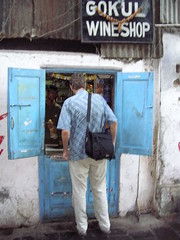 neighbourhood we are so fond of (including the Gokul, where we bought beer, and where a bomb was found).
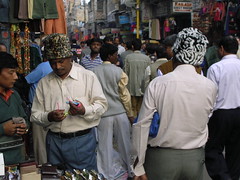 Delhi train station, had been the victim of a bomb blast last year.
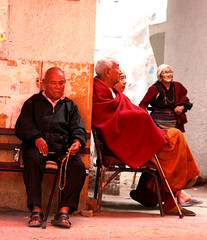 burgundy-robed community was watching closely.
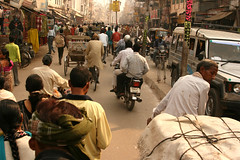 our visits here, we decided to stay outside of the noisy carnival of the old city.
 a duvet set we designed to be even more robust than last year, and some of the specialties of the area like the zardozi work.
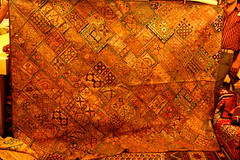 range.
 entrepreneur.
 and while it would be romantic to say it was a village of mud huts in the desert, the reality is that the village has come to the city.
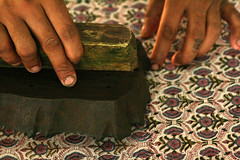
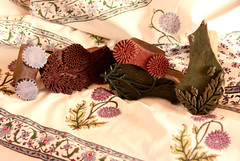 requires the use of five different blocks, applied by hand, for every flower on the sheet.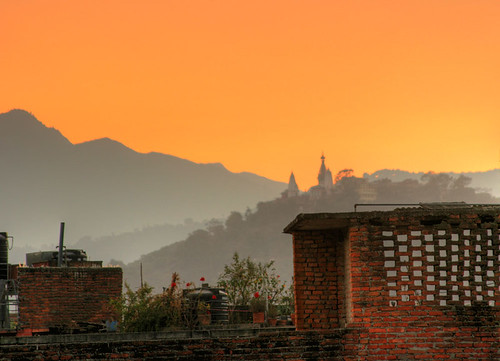
 The flight path from Bangkok to Kathmandu hasn’t changed;
 itinerant shamans, whatever the case may be. For the bicyclists who speed downhill -without a light of course – the effect must be absolutely hallucinatory.

 eye. On the downside, two people we felt a strong connection with are gone. Namgyal Lama, our shipper, who has always had a twinkle in his eye, and was known to the community as ‘Foxy’ for his wit and smarts has died of cancer; and Kasang who ran an antique store within the compound of the Bouddhinath Stupa was unable to survive the last year and is out of business. Malik told us the Chinese had recently stopped granting visas for non-resident Tibetans wishing to travel there, and this likely finished Kesang’s business off.
 character. A Tibetan yak drover for instance, would feel quite comfortable in the room in the old mansion that we find. It’s true, at 6’4″, I’m of somewhat different stature from the locals, and for much of the two flights of stairs up and down, the back and forth to the outside toilet, and walking about the primitive
 A short walk away is the old market and assembly area, the Dhulikhel, now a dusty flat ground surrounded by ancient banyan trees with an impossibly majestic view of the Ganesh Himal and the Annapurna range. It’s Saturday, the day off at the local girl’s school, which also attracts busloads of boys from the valley. They all gather at the Dhulikhel to mingle, play music, and have picnics and party. We fall in with a group of ravishing girls led by Shushima who give us flowers, practice their English, and call after us “Kat- a-rin, you are
  beautiful!”.
 and at one point, reflecting how many of us feel, pees on the floor.
 bougainvillea. Yes, there are scads of tourists, but there is also such a plethora of accommodation and services that we can find a lovely picture-window room with said vista for less than ten dollars. It is easy to wile away the days doing nothing but sampling the restaurants between morning
  it. This is also our last high point. It is downhill all the way to India. The descent begins with a long, long, staircase to lakeside.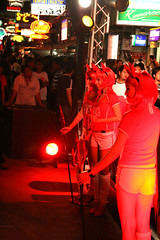

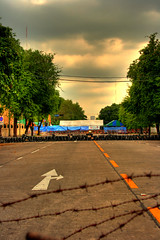 the PAD activists took control of one of the major streets lined with government offices, and barricaded themselves in with sandbags, tires and barbed wire. They are still there, and yesterday Katheryn and I went down to have a look.
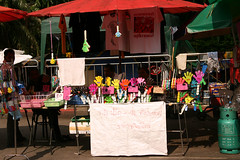 barricade. As we approach, loud music is pumping from a truck on which is painted “MURDER Bring the Killers to Justice”. A very pleasant young man apologizes that he has to search my bag, and then we are in. After the dour menace of the police side, it is very much like a carnival. There are loads of little eateries, the streets are lines with pavilion tents selling political merchandise, and there are at least three places I spot where you could stop for a foot massage. The hot ticket this oust-the-prime-minister season is the hand clapper. They started showing up at rallies in the spring – two glove-like hands on a stick that make a great clackity-clack when you shake them – and now they are a must-have for
  every demonstrator. Stomping on Somchai’s face is another popular theme, with his visage adorning flip-flops and bath-mats. And of course there are the T-shirts. Unfortunately the vendors here cater to a local crowd, so there are no XL sizes for me, and Katheryn doesn’t wear yellow (the PAD party colour), so we don’t buy anything. The sentiments, expresses as only T-shirts can, range from anger to resentment, with a smidgen of hope that the year 2551 will bring peace and change.
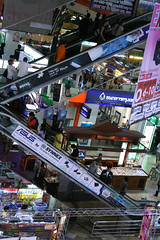 crown, which is much cheaper in this Kingdom than it is at home. Another thing that is cheaper is software, especially at the notorious Pantip Plaza, five floors of shops dealing with everything computer. I pick up a program that allows me to blend three different exposures of the same photo into one picture, making an HDR (High Dynamic Range) image. This lets us take pictures of high-contrast scenes, parts of which would previously have been over or under exposed, and produce some amazing results. Please bear with us while we indulge, and check out some of the pictures on our flickr site.
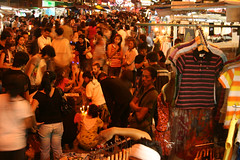 The friend thought a second. Is it an animal? So not having deep cultural roots, Halloween is just an excuse to party, which last night on Khao San Rd. is what everyone was doing. And then what happened? At around 10, just as the crowd was getting really thick, the thunder crashed and the lightening flashed and the sky finally opened. Everyone got soaked, but the party kept on going.
 The final leg of this year’s epic journey is destined to be Northern Thailand and Laos. We haven’t been to Laos in 2 years and we decide to go in easy stages to our ultimate destination, the 700 year old town of 20,000 people, Luang Prabang. We have an easy, comfortable train ride from Bangkok to Udon Thani in 9 hours. Unfortunately the double-pane windows are smudged and covered with decades of dirt, and even though the line passes through some dramatic scenery, we couldn’t see very much. In Udon Thani we got a fantastic cheap room with all the mod-cons. There seemed to be a fair sized ex-pat community living in this nondescript by likable northern city. From there the next day we took a short one hour bus to Nong Khai, the border town, with Laos just across with the Mekhong River. It’s
 star attraction is a very unusual park created by a spiritual leader named Luang Pu. He was a Lao who fled to Thailand when the communists took over in 1975, and he sculpted in concrete and supervised the making of colossal, bizarre images of Buddhist and Hindu deities, fashioning them in totally unconventional and often disturbing ways. The park is called Wat Kaek, and though he has since died the
  work is still ongoing. The faces, which are often 10′ high, characteristically have a blank, plastic quality that reminds me of Odo from Star Trek. One impressive statue is a 90′ high Buddha sitting under a very evil-looking 5-headed naga whose protruding fangs and tongues create an image a little removed from the benign teachings of the middle path. Still, it’s enjoyable in a very “Burning Man” kind of way.
 you have a lot of them.
 from the garden. We enjoyed these while watching the local kids leap into the river from a rickety bridge.
 everywhere. We take a very pretty room at the Cold River Guest house, with a view from our balcony of the garden, forest, a massive bamboo, and the Nam Khan, a tributary that feeds the mighty Mekhong. It feels good to have a place to stay put for a while; we have had been in 5 hotels in 5 days, a first this trip, but quite normal other years. Our hotel ,though lovely, should have been called “No water.” Due to its own pipes and town problems we often have no water, which is excruciating in the 35 plus weather with heavy sticky humidity. The hotel is favoured by Japanese travellers, who are very friendly. One evening they are sitting around and invite us to taste some local alcohol they have bought. Inside the bottle there is a dramatic cobra with it’s hood extended, biting into a large scorpion. No really, pickled inside the bottle! David, the fool, immediately said yes! He said it tasted like brandy.
 Shopping is our main reason to come here. We have a delightful source of hand loomed scarves and shawls, Phonsavan, and go to see her in the morning. We make our choices in a few hours and set about photographing it all on locations that say “Laos”. Though it was stinking hot, and we were soaked with sweat, we got terrific shots of the shawls, in temples and on old colonial buildings.
 smoke, and the sun always disappears well before it reached the horizon.
 over Buddha statues and poured gently over the palm of an elder. Nowadays huge coolers full of water are dragged to the curbside and hoses are brought out to soak the motorists and everybody who passes by. People sport pump action super-soaker water guns, and make a water war of all the streets. The enthusiasts in Luang Prabang start celebrating it 5 days before it is scheduled. When we had the stock with us and the camera it was a pain. But after that we are more likely looking for the soaking to cool off. It is actually quite a hilarious festival.
 4 days ago. We did find a decent room at a fair price, facing the now-unused airstrip the Americans built to conduct their illegal carpet bombing of the country during the Vietnam War. It seemed great until we saw the stage and tables and speakers being set up for the town’s celebration, almost in front of our hotel! The prospects for a good night’s sleep were looking grim. At least we had air-conditioning and it was stupid hot. But the party down the street used so much power it blew a fuse and blacked out our part of town. No more air-con. We opted for a mint-lemon juice and went to dinner, but following the theme of the day, they forgot one of our dishes. Things were just not going our way. But miraculously, probably because of the town-wide blackouts caused from the giant P.A. systems, the party didn’t go all night and we got a decent night’s sleep after all. We took a 7 am public bus to Vientiane, learned the long distance bus to Udon Thani was full, and decided to go south piece-meal. At every turn, with the festival in full
  swing, we were faced with inflated prices and constant bombardment with water. In Udon Thani the hotel situation was dire as well, but David, the world champion hotel finder came through, thoroughly soaked, but still grinning.
 A week in Borneo is K’s birthday present. As most of you know, she has a long history with monkeys. But an ape she has never met. There are only two places on the planet where the great red-haired men-of-the-forest, the orangutan, live: one is Sumatra; and the other is Borneo.
 store. She is a slim energetic blonde, and she and Peter are making plans to go to Burma together. In amongst this social action we also get together with Boris, our French ex-pat friend living in Bangkok. Unfortunately, Boris isn’t too keen on Thai food; but this is one of the most cosmopolitan corners of the universe, and we choose to eat (admittedly very good) falafel in a back alley place. Later Boris takes us well out of our usual stomping grounds, across the river to Thonburi where Bangkok still feels like a small Thai town, and then far to the southern edge of the city where a market sprawls along a network of canals.
 large, Frank and Kerry are full of fun and generosity. Frank was just back from Bombay when we arrived, where it looks likely he will be setting up an office for his company. The evening started out with wine, and wine kept flowing well into the night, as Kerry, a dedicated Chelsea fan, was staying up anyway to see her team take on lowly Barnsley in the F.A. Cup. The wine in this case was probably a good thing, as Barnsley stunned the football world by beating the powerhouse London team.
 What we get is a dormitory-sized room with smoothly polished hardwood floors and a view of a Chinese temple, a furnished balcony/sitting area, and a fully equipped kitchen. It is actually larger than our apartment, and would be a great place for a party. But there are stern signs demanding SILENCE, and a set of rules stapled to the door including an injunction against “merry-making”.
 Orang Ulu people.
 It’s a good thing we weren’t expecting an intimate wilderness experience, as the parking lot is full when we get there. However, there are orangutans in the trees, and they are so beautiful and rather quizzically philosophical about it all that it is easy to ignore the people. The old matriarch Delima is the star of the moment, with her youngster, Selina, clinging to her back. She is sitting on the ground a dozen feet away, deciding whether to dine at the smaller but closer platform in this clearing, or at the main feeding station 500m away through the forest. She opts for the forest feeding station, and she chooses the public path to get there. The park staff are frantically calling to people to get out of the way, “she is tempermental!”, as she lopes off purposefully over the foot-bridge. It is a covered bridge, and on its walls are pictures of Delima when Selina was just a wide-eyed muppet. The baby is now 3 years old, and Delima’s face is more lines and tired. It’s no wonder that she gets grumpy.
 over-head cables. He shimmies down the tree to the feeding platform head-first, reaches an impossibly long arm out to select a bunch of bananas, transfers them to his right foot, and turns himself around to climb back up the tree, bananas in his toes, all without a slip, a sound, or a strain. Then he dangles himself in mid-air holding the cable with his right hand and right foot, and has breakfast.
 forest, and for reasons of his own wants to have a good look at at his odd primate cousins. He settles into a tree right beside the path as we approach. His eyes are dark deep still pools. He is calm, and un-threatening, and although most people have stopped I continue walking past him, within a few feet, in as relaxed a manner as possible. K., I know, resists the temptation to invite him to house-sit in Vancouver (or alternatively join him off in the forest), and we walk back out of Semenggoh, satisfied with out experience.
 Kuching.
 have seen numerous macaques, a bearded pig, monitor lizards and two beautiful, chartreuse, diamond-headed vipers. A short afternoon hike out to Teluk Paku takes us through jungle like jungle was meant to be. The air is as hot and humid as a sauna, and so fresh it feels as if we are breathing pure oxygen. Small streams bubble out of black caverns, tree trunks rise straight and smooth into an unbroken canopy, and creepers and vines cover everything. Up above us in the tree-tops there is a rustling sound, and we spot one of
  Borneo’s unique and famous citizens, the probiscus monkey.
 the water has perculated through the loamy underbrush, and is the colour of dark tea. K is somewhat reluctant at first to go into the opaque, unfathomable jungle-lines pools, but I am too hot to care, and plunge in.
 Then, however, we get in a boat, and then a bus, and then a taxi, and then a plane, and then we are in Penang, and then next morning we catch another flight and we are back in Bangkok. All of a sudden everything is completely different. But this is Bangkok, and it is where trips begin.set:72157604327549665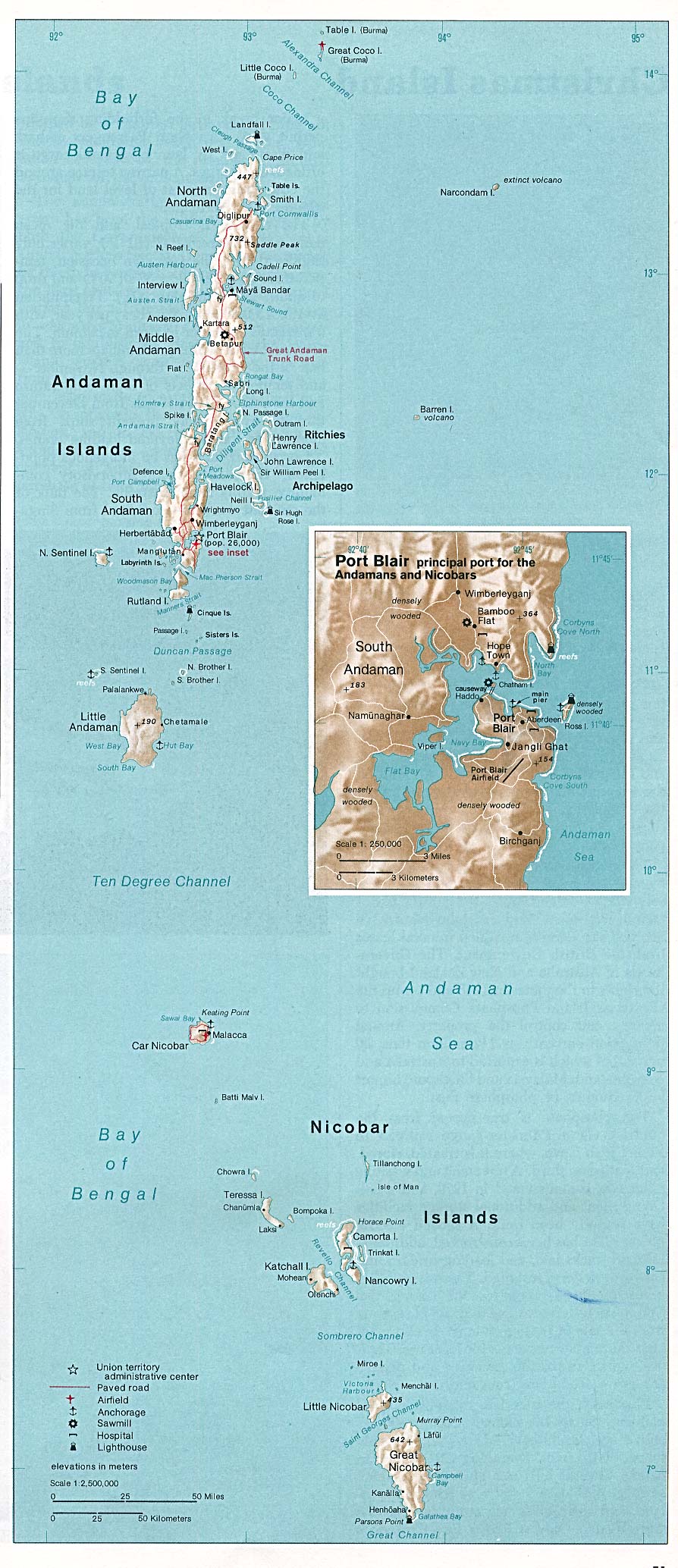

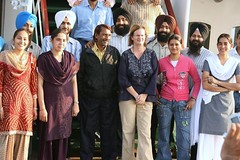 captain was from the same village as some Punjabi folk dancers en route to a dance festival in Port Blair. They, and 3 other groups, were invited to use our deck to practice, then on the final night, a formal performance was arranged with full costumes. We dressed up for it, like you should when one finds oneself at sea.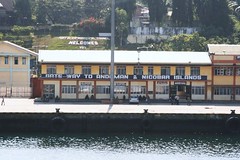
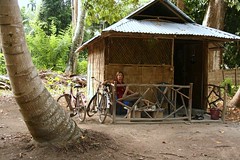 concrete bathroom floor, comfy bed and pleasant coconut grove garden for 400 rupees (about $10) at El Dorado. The plan was to stay on as long as were we happy. After a few days we managed to score the hut nearest the beach. At sunrise, through the split bamboo, magical little beams of light danced everywhere. We heard birds, crickets and frogs along with the lapping Andaman sea while lying in bed. We stayed three weeks. There was an array of wildlife incidents in our bungalow. We had a small black scorpion that David shook out of his shorts before putting them on. A large cockroach and similar sized crab both took refuge on our soap dish,
 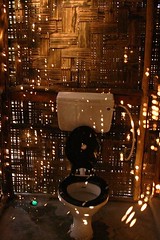 though not together. The bamboo bathroom wall could never dry out so there was a slight but ever-present aroma of mold, and every few days a tiny clump of gun-metal grey mushrooms would crop up at the bottom of that wall, but would be efficiently removed by the tireless army of ants. Sitting on our balcony at sunset, without fail, we would greet a passing frog, no doubt on his ancestral route past the right hand corner of our cabin. Surprisingly though, sitting on the balcony as night fell, our light attracted nearly no flying insects. The daily presence of fine saw dust under all the bungalows beams, showed evidence of another tireless insect colony, which would likely eat the whole cabin within a year.
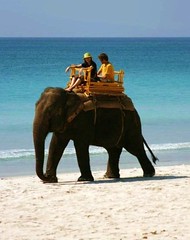
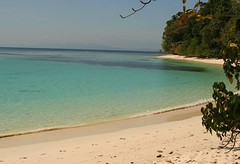 fine clean white sand. Simply extraordinary. Twice, while standing by the entrance to our beach, a newcomer would try to say hello, get their first glimpse of the colour of the water, and not be able to say hello, because they had to say ‘wow’. The lack of pollution was astounding, unprecedented in my trips throughout mainland India. A solar plant provides some of their power needs and we never suffered long power outages. Internet access was very limited though, and even phoning was a problem at times. It felt nice to be unconnected.
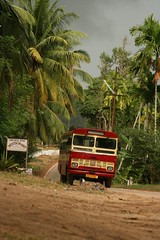 on the opposite side of the island. Our bus, for pennies, dropped us in town (the mid island’s Village Number Three) just 5 minutes away, where we’d have time for a roti cannai and chai breakfast before our second bus arrived. It would take us past the teak and thatch homes (or sometimes cinder block and tin), past rice paddies and palm forest, past dense vine-heavy jungle to the finest beach we’ve ever seen, called, prosaically, Number Seven. If you don’t believe us, Time Magazine called it the world’s best beach in 2004. It was a half an hour walk from the bus to the where the snorkeling was best, on a path through a mature tropical hard-wood forest (including the Giant Dum Dum trees) with jungle-covered hills on one side and the azure ocean on the other. The trees were tall and straight, with silver-smooth bark that looked like dinosaur skin. The bottoms often sported wide buttresses, and high, high above our heads the tree tops resembled broccoli bunches. Magnificent mighty trees, and given the scale of the
 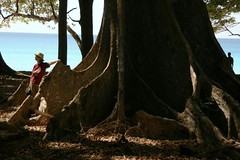 logging over the last century, shockingly still standing. Port Blair once had the biggest saw-mill in all of India, and only 10 years ago did the cutting stop. That this century-old hardwood forest with such easy access on a beach-front never got axed is a miracle. The snorkel beach provided shade, had wonderful fish and okay coral. The most impressive of the fish were the Napoleans. About 50 of these massive coral-eaters stayed fairly near shore, very unaffected by our presence, solely interested in munching the hard coral. You often heard them before you saw them, but with a large bump on their head and weighing in at about 40kg each they were quite the sight, especially since they had no fear or interest in swimmers, and we could be literally moving right among them. A myriad of other tropical fish were seen and of course the thugs of the ocean, the barracuda. On the beach there were no bars, no venders, no music, no jet skies,
  no beggars, and no tourist boats pulling up dropping off groups. There were only ever a half dozen people there. No kidding.
  frequently enjoyed at one of the ‘meals ready’ shacks, a rice thali for 50 cents, by the bus stop at Beach Seven. Beer was the same price everywhere, 100 rupees, even at the gorgeous open air Italian restaurant overlooking the beach, so naturally it became our ‘local’ for our ‘sunset beer’. This simple and pleasurable existence was easy, finding ourselves saying frequently, with emphasis,” this is really nice.” It was a breezy 32 degrees everyday, low bug issues, good transportation. We had so many friends we’d sometimes even avoid people. We both turned the colour of Macintosh caramel and neither of us burned (too much) or got eaten by a shark. We didn’t even see a shark, except on the menu.
 Island. By development, I mean it has 3 guest houses. The situation for buying a boat ticket was, again, the only part of the whole place that reminded you that you were still in India. Because there was a ‘women’s queue’ I stood in the throngs for hours struggling to keep my place, pushing and throwing insults just like the next in line, a tiny, sari-clad ruffian. The majority of the tickets are sold for triple the price on the black market to tourists at their guest houses, and after a four hour wait for the window to open, only 4 people were served before they closed it. I persevered and secured us passage but had a smoldering feeling of violence that affected me all day and even seeped into my dreams.
 you can swing it, GET THERE NOW. THIS IS ONE OF THE LAST GREAT UNSPOILT TROPICAL ISLANDS.