
The Bali Shipment

 The last time we blogged, we were in the S.E. corner of Sabah, Borneo, waiting for an Indonesian visa and a boat to take us to Tarakan in Kalimantan. The purpose of this was to make a more direct – although less-travelled – route between the Philippines and Jogjakarta in Java.
If “Tarakan, an island city in Kalimantan, Borneo” sounds intriguing and exotic in a Joseph Conrad way, the reality is a bit more mundane. Notable moments came when our boat docked and the cabin door was opened – and we were stormed by an invading force of motorcycle-taxi drivers. They barged through the first row of passengers, including us, in their haste to secure fares for the long ride down the pier to customs and immigration. Welcome to Indonesia. We, of course, walked, and once there had to smile and mime our way through an inspection of Katheryn’s bag which turned up two suspicious items: tampons and a bag of black peppercorns. Both, apparantly, unknown in the world of the (male) inspectors. Our verdict on Tarakan? Nothing exciting. Although all we did there was spend an evening wandering around finding food, accomodation, and a ticket out.
The ticket was for a flight, ostensibly in the morning, to Surabaya, Java. Surabaya, known as the “necessary evil” of Java, is a massive city on the central north coast through which everything passes. Our plan was to go straight to the station and take the 4 p.m. train out, but our Lion Air flight being 5 hours late put paid to that. We were forced to arrive after dark and  spend an overnight. Nothing unpleasant happened; still I can’t say I hold the place high in my affections, and we were thrilled to be rolling out in the morning into the lush countryside of central Java.
We gave Jogja a chance. We spent days wandering the markets and shops by foot and becak,  and went by motorbike into the surrounding villages. We found painters and potters and sculptors and sewers – but apart from discovering a great big stone monument called Borobudur, it wasn’t what we were looking for. We had better luck in Solo, a more conservative, less touristy city nearby, known for its massive textile market. There we bought a few samples, and one superb piece: a copper batik chop. If we go back, it will definitely be for Solo rather than Jogja.
Back in Bali, and for the first time since leaving Vancouver we are on familiar ground. We have a little Honda motorbike, a room booked in Ubud, and it’s time to get down to work. OK, this is  the fun part of the job: scooting around a stunning tropical island, meeting friendly craftspeople and giving them lots of money for beautiful things. Then again, there are the torrential deluges which periodically catch us out far from home…
The first stop is our Timorese friend Victoria, and her great collection of tribal art. We were sold out of her coconut tree masks before the end of last season, so this year we are getting more. I will put a price list below, so anyone interested in reserving a specific piece can email us, and we will give more details and set it aside. Victoria  also had some new masks which caught our eye. These come with the metal stand.
Next we dropped by Wayan. Of all of our contacts, he is one of our favorites. Like most Balinese, he seems to take life as if it was a ripe mango dropping, pealed, into his open mouth. Yet for all of that, it  hasn’t been as easy year for him, and the stress shows. He is our umbrella and Balinese banner (umbal-umbal) man, and apart from running the shop he and his uncle do most of the sewing. With a young family he is struggling to make ends meet, so our order, the biggest ever with him, came at a welcome time. Apart from the whimsical banners (if you want rainbows, order now!) we are buying his hand-made 2m diameter patio umbrellas, as well as smaller decorative table top ones.
Southern Bali – from Ubud to Denpassar to Kuta – is an unbelievable road side shopping experience of small and medium-sized producers. Apart from the sheer quantity of inventory, what is almost as stunning is how much dross there is. After awhile you get repetitive craft  disorder, and just can’t look at another identical coconut Buddha, and you wonder who can possibly be buying all those tacky maiden-in-a-rice-field paintings. The same is true with the cast stone sculpture. There is so much of it – and a lot of it isn’t bad – but the trick is to find a small business you like, and who does quality work on site. After MUCH looking, we met Gus, who had beautiful pieces, and was able to walk us through the process in the workshop behind his tiny store front.
It’s similar with the metalwork. We are buying lamps this year for the first time, and we  sourced out Jero, who we like for her enthusiasm, and who makes everything in a small family business out back.
The last items we are shipping out of Bali are not easy to find; they aren’t in every second shop on the road side. Maybe that’s why we love our New Guinea pieces – they were a lot of work! One memorable day, trying to re-find a small shop with these amazing necklaces on the edge of Denpassar, we spent 4 hours fighting unbelievable traffic  through the city. I am crazy enough to consider city driving in Asia fun – you aren’t constrained by rules like “stay off the sidewalk” – but this was exhausting (literally). We finally bailed out of the humidity and pollution to a small restaurant, who gave us some directions. Back on another 6 lane horror show, after negotiating another chaotic intersection, my prized progressive lens glasses made a suicide leap out of my shirt pocket into the middle of traffic. Miraculously, after we pulled over and ran back, they were still alive – until the last truck taking the corner scored a direct hit. And we never did find the shop.
But now I know where it is, and we spent a lot of time with Kadek, and her near-neighbour  Andi. The necklaces are all wearable, but also come with the stand, and are displayable works of art. Andi’s shields come from Jayapura, Irian Jaya, and could also conceivably be used in a skirmish/raid/war with your enemies. Perhaps better just put them on the wall. Kadek’s necklaces, she is honest enough to tell us, are made by her in Bali, in the Irian Jaya tradition – except for one style. These elegant sculpures, called Kalabubu, come from Nias, off the coast of Sumatra. Kadek is an expert, but she says people here lack the skill to reproduce them. They are as smooth as bone or horn, which is what they look like, but they are actually polished discs of coconut shell, with a brass clasp. She only had two, and we are keeping one
  for ourselves…
I am currently putting the new stock up on our website. Please check it out by going to https://www.kebeandfast.com, go to “our store”, and look for these goods in “jewelry” and “arts and crafts”. Below is a sample of what we have. If you find something you love, please contact us by email about details, delivery and payment. You can reach us at: sales@kebeandfast.com.
Terima Kasi,
Your Foreign Devil Correspondents

Coconut tree mask from West Timor. @ 1m tall. $200

Wooden mask with stand. @1m tall. $180

Bali banner (umbal umbal) colours. 5m tall. $15 each, 6 for $50, 10 for $100.

2m diameter waterproof patio umbrella. Available in yellow, teal, white and purple. $180.

Table top umbrella. Available in orange, white, yellow and purple. $35

Cast stone bust. 53cm on stand. $90.

Buddha bust. 36cm on stand. $35.

Cast stone Boddhisattva bust. 32 cm. on stand. $35.

Metal and polyester standing lamp. 30cm tall. $35.

Metal and polyester hanging globe lamp. 23cm tall. $35.

Wooden shield from New Guinea. @1.3m tall. $120.

Wooden shield from New Guinea. @1.3m tall. $120.

Irian Jaya style shell neck lace. Including stand. $150

Irian Jaya style shell neck lace. Including stand. $85

Irian Jaya style shell neck lace. Including stand. $120

Irian Jaya style shell neck lace. Including stand. $75

Irian Jaya style shell neck lace. Including stand. $85

Irian Jaya style shell neck lace. Including stand. $75

Kalabubu necklace from Nias. One only. $250.


 swimming pool – that he has booked for us: that’s how easy this has become! However we have come a long way from Kathmandu, 46 hours of travel in 5 days, which leads us to the umbul-umbul.
 cloth maker. They are all 5 meters tall and will retail at our sales for $16. We are stocking the colours you see in the photo (for a bigger image double click it) although quite a few (we cleaned out Wayan’s stock) are in limited numbers. As a special offer* and if you order NOW they are on sale for 5 pieces for $60 or 10 for $100. Keep in mind how charming they would be at all those parties, weddings or special events coming up this summer. If you are interested, let us know by email: katheryn@kebeandfast.com and we will set aside your selection. When we are back in Canada in the middle of April, we will contact you about payment and delivery details.
 The big story in India this January is the ‘Cold Wave’. Everybody knows the daily low temperature, how much it is below average, and the grim statistical death-count it has caused (643 and counting) . The cold moist air that comes down from the Himalayas creates a huge fog bank across the northern plains every evening as the temperature drops. Depending on conditions and where you are,
 morning at least – is that we get dropped at the end of the bridge over the Ganges River, and hire a boat to row us the final 2 km to our guest house.
 a timeless vista: on our left the bank is completely deserted; on the right stone steps continue the rise from the river into an idiosyncratic geometry of palaces, temples and houses. A beautiful scene unfolds as we near our landing, Scindia Ghat: washer women are holding up long lengths of bright sarees to dry, forming a multi-coloured mandala.
 constantly coming in with more bundles. In between this philanthropy piles of silk scarves are unfurled at our feet, and bed spreads, and cushion covers, and tea is served, and food, and more tea.
 alms. Professional beggars, snake handlers, the handicapped and the poor line most of the approaches to the river, and receive, typically, a sprinkling of special rice, “khichori”, from the pilgrims. After their dunk in the river, many worshipers also leave their clothes behind to be picked through later. Ajit tells us that some of the wealthy even leave gold bangles and Rolexes behind. It is also a day to give clothing to the poor of an untouchable caste, and they walk through the streets of the old city, making their request with a half-sung half-shouted rhyming verse. By the time the moon has moved away from the sun – about 2:30 – there are tens of thousands of people along the banks of the Ganges River. More are ferried in over-packed launches to the other side, a wide sand bank, where it is much easier to get into the water. We have left the
  impossibly –congested ghats for the space afforded by a boat. From this perspective the crowd changes from a collection of individuals – some singing, some dressing, some just waiting – into a single flowing creature, a river in itself. This is India, and the river and the city and the country always has something more to throw at you. As we are rowed along in front of the worshipers, the body of a young boy floats past – the boatman has to raise his oar to avoid it. He is face
  down, and there will be no answers to who he was or where he came from. It is a startling sight, but I have to think of it as the boatman does: meaningless, now that the life is gone; more matter, returning to the water, the earth, or the fire. So life goes on. And so much life goes on that there is no time to pause; the crowd chants, and surges, and submerged in the water purification is given.
 negotiating for a leather bag, and the dealer’s first line was “sugar is twice as expensive!”. In Varanasi it is the same: cotton is forty percent more than last year; and silk yarn has gone from 1600/rupees a kilo to 2400. Everyone is pointing fingers, but in general it comes down to two things. One is good: a general increase in wealth in the country. And one is bad: hoarding by speculators, and the newly-created futures market for agricultural commodities. The merchants that we deal with in India operate on small margins, but have always been (like us) very reluctant to raise their prices. This year they have no choice, and we willingly pay them more. In the case of one of the products most dear to us, the price has increased almost 40%. These are the silk scarves and shawls from Varanasi that we call in our display “Simply the finest hand
  weaving we can find”. They are extremely beautiful, intricate hand-woven silk made by a Muslim community outside the city. When we started buying them eight years ago, there were over 70 weaves making them. Because of our special relationship, the price remained unchanged until this year, even though the art is dying out. This year there are only 12 weavers left, and with the price of silk at record levels, the increase was unavoidable. We have decided to keep our price the same, on these masterpieces for one more year. But this is your last chance! After this, they may not be available, at any cost.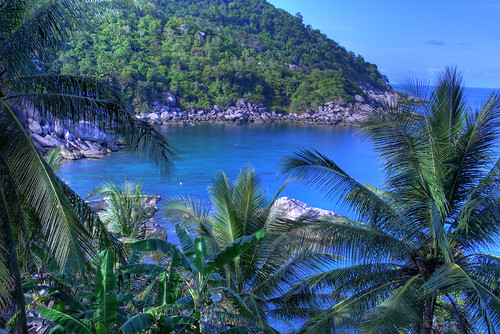
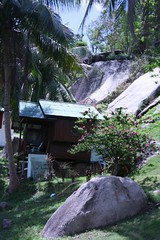 don’t count the one next to it which the owner says is haunted, and they never rent out.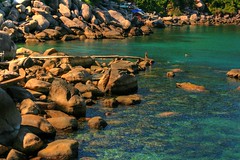
 Another good thing is that there is only power from 6:30 pm until early morning. This gives K a maximum of about 4 hours of battery time on the laptop, and then we have to do something else, like go snorkeling. Koh Tao is an international diving hot-spot, and in fact issues more PADI certifications than anywhere else in the world. We, as snorkelers, are the scooter riders of the underwater biker community, but the scenery off of our rocks doesn’t make us feel second class. We spend much of the day swimming around our 3-dimensional screen-saver of a reef. Next time I’ll come with a water-proof camera, and show you just how beautiful it is.
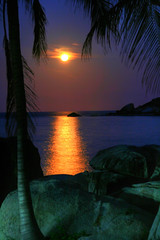 and windows open. The night after, however, there were such swarms around the bulbs that in the restaurant Soe, the owner, was scooping them away with a mixing bowl. There was a definite spike of activity that night, but it hasn’t been the same since. Now we have to close our door before we turn on the light, which still didn’t stop a beetle the size of a hamburger patty from trying to smash it down.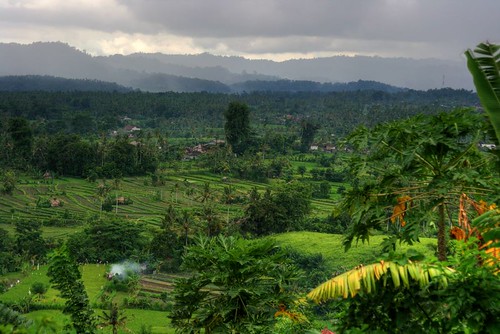
 throws, and taking the country down with it. People were rioting for food, atrocities were being committed against the Chinese and Christians (often the same thing; and often the scapegoats when things went bad), the Australian army was air-lifting their nationals out of the country, and the currency was close to being worthless. It was a traumatic time. A similar but bloodier scenario brought Suharto into power in 1965. I was only 4 at the time, but my family, who were living in Java, also had to flee the terrible circumstances. I went back in early 1982. At the time Kuta Beach was a quiet back-packer haunt, Legian was a separate village, and Ubud didn’t have any Italian restaurants. K had warned me it would
  be a shock to go back, so we have, over the years, left it off of our itinerary.
 that kind of power is.
 everything is made on Java. This is certainly true with the textiles, although we find many pieces from Sumba and Flores as well. We spend half a day in the cloth market in Denpasar, and are fortunate enough to meet Supriadi and his daughter Farhana. They are from Malang, in east Java, where I spent my childhood, and this connection is maybe why they give us the straight goods and the “harga bihasa’, the ‘real price’. We end up buying as many sarongs from them as we can carry on our bikes. Batik, of course, is an Indonesian word for the famous resist-dye process of applying wax to cloth. Although not a dead art, hand made batik is now mostly a high-end artisan-produced specialty. Most merchants will try to con you with either the very cheap “batik prints”- easily detectable because only one side has vibrant colour – or “machine batik”. These are actually true batik, except that the wax pattern application is done mechanically, and are impossible to distinguish from the hand made article- for me, anyway- except that each pattern is identical in every detail. In the end, the sourcing experience in Bali has made me appreciate even more the quality and the diversity of the hand-made culture in India.
 pared-down pack – which sits between my knees – on a short tour of the island. In fact everything is so beautiful we don’t end up going very far. The first stop is Ubud – a short jaunt inland – which has been a magnet for ex-pat artists since the ’30’s. Many foreigners have continued to settle here, and it is easy to see why. Ubud is built around a number of steep ravines and river valleys. Some of the most stylish
 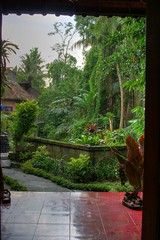 boutique hotels in Asia are built into the lush green slopes and we voyeuristically wander into some just to look around. The staff see through our grubby gear right away, but are always smiling and gracious. The great thing about Ubud is we can get a chi-chi room for economy rates. Peter shows us to a real gem: lovely gardens, a swimming pool, lotus pond, with our room individually set into the jungle above one of the rushing water courses – for $14! Again we curse ourselves for not budgeting more time here. It’s almost a blessing that for much of the next two days it rains torrentially in Ubud; we have to cosy up in our lovely room as the rain thunders and the thunder rolls.
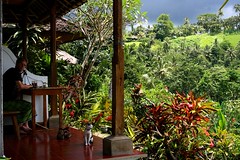 our guest house. Palm trees pose dramatically above a ridge of wild grass, patches of jungle foliage explode like green bombs frozen in time, and thick creepers try to blanket everything. The real eye-catcher though, is the elaborate rice terracing. The terraces transcribe every surface with an anarchic geometry, each patch a perfect shade of spring green. As if this wasn’t enough, people and nature have thrown extravagant colour into the mix. Frangipani and hibiscus and bougainvillea tumble from the garden in front of us; the butterflies are almost too much of a hyperbole to mention. A hummingbird with a long curved bill hovers for a second and nearly breaks my heart. Once you get over that there are the towers of clouds sailing
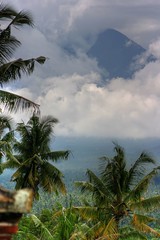
 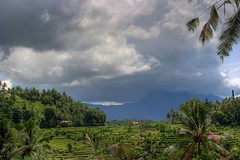 through the skies. They can be real drama queens, flouncing up their skirts, pouting black, giving mischievous glimpses of a huge volcano, and glamming it up for the carnival of sunset.
 long sarongs, and hopping through the thin, often muddy terraces, isn’t easy. As we get closer we see that, of course, there is an easier way, and on it are many men in traditional costumes and women carrying baskets of fruit and offerings on their heads. The Balinese love ceremonies, as one young man explained to us, not because they are necessarily deeply religious, but as much for the art and tradition. You could, in my opinion, make an arguement that there is very little difference.
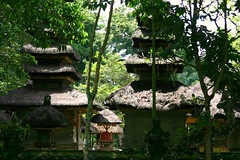
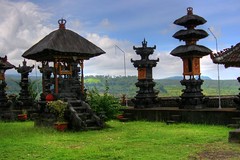 manicured landscape. The going is relatively easy, if a little indirect, and the worst thing is the over-protective dogs who always have to bark, and tell the next dog along the line that we are coming through. Eventually we reach the hill. For the first time that day, within sight of the temple, the paths vanish. The air is stagnant and the humidity is oppressive. For a couple hundred meters we are the suspicious focus of every dog in the valley, as we pull ourselves up the steep slope through thick elephant grass. The reward is a spectacular view – and of course, an obvious and easy way down. K. is enjoying dredging up some of her language skills unused for a decade, and jokes with locals that we pass.
 from here too soon.