
Tongba, Raw Yak and a ’97 Langdeoc


 I am 27,000 ft above the plains of northern India. They couldn’t be flatter. Big rivers meander across them like fat pythons, leaving tracks of sandbars and abandonned ox-bow curves. I can see villages stretched along the banks, and everywhere the geometry of fields. The only places where there aren’t any signs of human impact are the flood plains themselves, reluctantly left alone because of the power of the monsoon. Earlier this year the floods hit hard; the rivers broke their banks and milions of people were displaced.
I’m sure most of the people below me, plowing fields with oxen and hoping for the best from season to season have never seen what I am looking at in the distance: the massive white peaks of the Himalayas. I don’t think that anywhere else in the world are two such different landscapes existing side by side.
Our flight path follows the chain of mountains with the legendary names: Kanchenjunga; 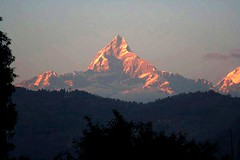 Langtang; Everest. Or is that one Everest? Well, it could be- it’s big, white, and in the Himalayas…
It’s only when we turn north on the approach to Kathmandu that there is any break from the relentless human-scape below us. The Indian plains dash up against the first foothills, and forests spill off their flanks. Katheryn and I have crossed this route several times on the ground, taking a day on hairpin curves what we now do in 10 minutes.  Kathmandu’s airport is rapidly becoming engulfed by the sprawl of the city, and it looks like we are going to touch down amid the flat-roofed three story concrete buildings as we approach the runway.
Unlike last February, when we were cold, wet and socked in, it is now all sunshine and short-sleeve weather during the day, although it is still cold at night. We soon get down to business with Malik, our Tibetan-Muslim born-in-Nepal jeweler. After a bit of badgering he agrees to take us on a tour of his workshops. The production system here is still very old-fashioned and informal. There are metal-working, silver-working, and stone-setting “castes”. Most are from the villages, and much of the work in done there. Malik takes us to a couple of places in the vicinity of the city, although most of the workers have gone home for a few days since it is a festival time. Production is very small-scale. We go to the work-shop of Kishan, who lives with his family in a farm house outside the city. There they are making some of the beads that we buy – beautiful creations of turquoise and coral and brass.  Kishan supervises the operation. In the winter there might be ten men working here. Now there are only two – the rest are back home for the harvest and the festival. They are paid by the piece, and make $200 to $300 /month, about the same as a teacher in the village, and are provided with room and board.
As a small independent business, Malik has his own problems to deal with. Ever since the deposition of the king last year, the Maoists have been flexing their power in the city. Particularly problematic now is the “youth wing”, who have taken to the fund-raising strategy of extortion. Although Malik is reticent to go into detail, it is evident from his response that he is  worried. It’s enough, in fact, to make him consider leaving Kathmandu and the business his father established a generation ago. Malik is 55, although with his black hair, smooth skin and perfect teeth he could be 20 years younger. Like most Nepali he views life with acceptance and good humour. He has worked hard to provide an education for his three children, and owns his own home, which he is very proud to take us to. He doesn’t have a car, but in a small city with chronic petrol shortages, he doesn’t consider this a big concern. Malik is determined to provided us with that essential of Tibetan hospitality, yak-butter tea. Several times on the way to his place he asks if we have tried it, as if breaking us in for something. In fact the last time I had it was more than 20 years ago. It was in a shepherd’s hut high in the Himalayas, and the concoction of fermented butter, hot water and salt was so nauseating I haven’t been tempted since. Malik assures me this isn’t the same – it’s made from a package. Malik’s wife greets us, and we are made at home in the family room while she prepares the tea. I think other foreigners have tried and failed this test, as there is a hovering expectancy, a compulsion to preform this ritual even though disappointment is inevitable, as the tea is brought in. It is white and frothy, but doesn’t reek of rancid socks – my visceral memory from the last time. I raise the glass. Silence, tension. I try it. Mmm, that’s good! The relief is palpable. It tastes a bit like salty chicken soup stock, and although I wont, say, switch from coffee any time soon, my reaction was not just being polite. Encouraged by their small success, the next thing to come out are the homemade butter biscuits. No problem there, and even Katheryn, who had not made much headway with her tea beyond smiling at it, is enthusiastic. Now Malik seems prepared to take a gamble. He prefaces it with the story of his wife’s last trip to Lhasa to see her mother. She had brought back something very special, a delicacy you couldn’t get here. Raw dried yak. Sure, I said, is it smoked? No, only dried. Cured with salt? No. Tibet is very dry. And cold. OK, maybe a small piece…
The bowl of raw Yak comes out with the beaming wife. Malik, sensing a crisis, officiously sorts through the scraps. Here, this one. He proffers a piece that looks like a section of leather belt. You see, only meat, no fat. Many of the other pieces have thick gray borders around them. It is tough, like I expected; and then something marvelous happens. It becomes soft, and sweet, and literally melts in my mouth. We hope to go to Tibet next year – can I take orders for anyone?
Thamel, the area of Kathmandu where we live, is a chaotic few blocks of shops, guest houses and restaurants. One of our favorites is a little Tibetan place tucked back behind a row of shops called Gurung. It has the best tongba in town. Almost always there are locals sitting around in the dim light, on their tables flagons with metal straws sticking out of them, and a thermos of boiling water. In the flagons are a couple of cups of fermented millet, like coarse dark sand. Hot water from the thermos is poured on top, and after a few minutes it turns milky. The metal straw is pinched and perforated at one end, so that none of the grain mixture is imbibed when you take a sip. Tongba has a slightly sour, saki-ish taste, but is very mild. Hot water is continually added into the flagon, and after a litre or more, when the flavour starts to diminish, it feels much the same as having drank a beer. But on those cold Kathmandu evenings there is nothing like it.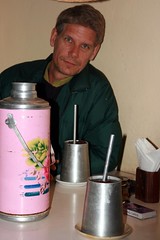
For something a little more up-scale we head out of Thamel, to one of the world’s funniest liquor stores. The American embassy is in the kind of compound you would expect, all concrete bunkers and razor wire, across from the deposed king’s royal palace. Set into the embassy wall is a faux-tudor shop front. Inside, if you poke around and wipe the dust off the labels, are bargain treasures of French and Australian wine. Katheryn, of course, is the authority, and since the staff only know two words – “red” and “white”, she takes command, and comes up with $7 bottles of 1993 Austrailian Shiraz, and a sublime 1997 Languadoc. There is no need to suffer, even in a Himalayan ex-Kingdom.
Pokhara Nov.25 The banana trees and bamboo groves are in extreme juxtaposition to the giant craggy snow capped Annapurna range. Machchaputare peak dominates our rooftop  view. The fish tail mountain is sacred, and never been summited. Mountaineers can only go within 100 meters of the top. Annapurna II and IV, David guesses, are the two other big boys in our back yard, and measure in at around the 8000 meter mark. We arrived by rather luxurious bus yesterday. Having upped our budget by 50% we can splash out on the $15 ticket. Lots of leg room, decent lunch provided, no music, didn’t take on passengers or let others alight mid-trip – and no chickens, sacks of onions or bundles of steel pipe underfoot.
But a good bus doesn’t mean good road. Our 200 km ride from Kathmandu to Pokhara takes 8 hours. The highway, dramatically cut through the terraced hills, is not too bad, really. Only a few times were we bounced right up off our seats. The roads in the city, however, are as bad as anywhere I have seen, ever. Dust, and potholes, staggering congestion and failing infrastructure; at least an hour and a half of the journey is just trying to leave the city.
As we get further away the capital the villages become more traditional. Stunning stone houses and fences, possibly centuries old hug the hillside.  Drying corncobs give a picturesque detail along the glassless window frames. Beautiful as it looks, this is tough living. People eke a livelihood from two-foot-wide rice terrraces carved 1000 feet up the slope, and water has to be carried long distances from gravity fed water taps sticking out of the trees. It would be a real struggle to provide one’s basic needs.
Struggles aren’t uncommon throughout Nepal. The last few dramatic years have led to many changes including the slaughter of the royal family, the uprising when the King’s successor dissolved parliament, the laying down of arms and the official end of the insurgency by the Maoist rebels.
All this progress couldn’t continue withhout as hitch, however. Earlier this year the Moaists, who had been invited to participate in legitiate politics, walked out of parliment refusing to vote for the constistutional assembly until the monarchy was abolished and the rebublic was formed. That’s about where we stand. Jimmy Carter dropped in to see where there could be a meeting made. The Maoists have returned to there extorting ways demanding payent once again from foreign trekkers and from the locals. Though we still believe the future looks brighter, the locals we engaged with would actually go into rants and tirades about the government. One old (and maybe drunk) man in the tiniest tea shop (really, it had a 4.5 foot high ceilng) carried on and on about how communism was the only answer. Our waiter who we’ve gotten to know over the years also went crazy one night raving about the changes needed. He apologized profusley afterwards, but he couldn’t stop himself at the time.
On the day before we leave for India we take a taxi to Sarangkhot, a village on a ridge 2000 feet above lakeside Pokhara. This is where the paragliders  launch from, and it provides stunning views all around. We stop at a small shop for breakfast, and have tea with an incredible vista of Machchapuchare and the Annapurnas. I don’t see the need to go the remaining few hundred metres to the top of the hill, but David is keen, so I sit in the sun and talk with the owner. She has problems. During the monsoon in August, a landslide took out the slope in front of us. Then another one directly behind took away her buffalo paddock. There isn’t much land left on the razor’s edge we sit on, which represents her life savings. To stabilize the slope with concrete she estimates will take a year’s income, and even then nothing is gauranteed. She says that there has never been a monsoon as severe as this last one, and is willing to take her chances. It seems to me, though, that she is another casualty of the bigger climate disaster we see everywhere, and more severe conditions are what we can expect.
When David returns, he has another plan: hike down the mountain to Pokhara. It looks to me like it’s a long, long way… With a kind of voodoo instinct he finds a path, and on a rough stone stair through small villages and bamboo forest we begin the big descent to India.
set:72157603397934869
 We left the shady streets by Rambutri Wat,Banglaphu, on the mini bus for the airport at 2 pm. We have a flight to Kathmandu thru Dhaka on GMG airlines, which will require an over night stay in Bangladesh. After last year we decided we preferred this over flying to Calcutta and going overland thru Bihar to Birganj. We all remember what happened in Birganj last time? (check ‘Escape from Birganj’ in the
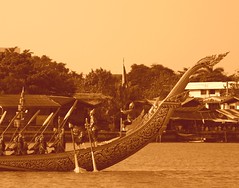 The commemorative procession of royal barges was to start at 3:30 on the Chao Phraya River. Tickets for the grandstands were being sold for 800B, but we could view at a nearby park for free. I got a front-row spot by the rail by 3:00, and held it while David sat out of the sun as he didn’t have a hat on and I did. This centuries- old tradition of very long decorated barges takes place only periodically, this being the 16th time in the last 60 years.
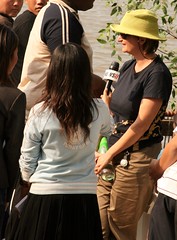 and the host asked if I was willing to be interviewed for the evening broadcast. Naturally I complied, although I hope that the viewers will be mesmerized by my wit and wardrobe, since I hadn’t done much homework on the reasons for the ceremony, which is what she was asking me about.
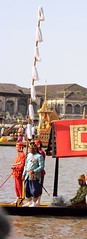 decorated staves on the wooden deck could be heard. It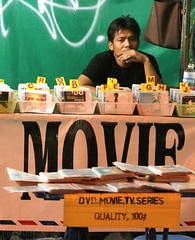
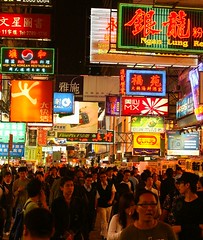 Hong Kong 10 years on.
 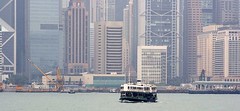 Star ferry to all the various theatres around the city then promptly flew to Canada for 2 weeks. On my own in Hong Kong I found the place completely perplexing. It was a not stop construction zone, so many jack hammers I wore ear plugs walking outside. The crowds were so intense you frequently felt someone’s shoe under your heal before you lifted your toe to take a step. There was tremendous difficulties ensuring the food I was ordering would be what I wanted. The pollution made my eyes red and puffy. It was also, in an historical footnote, where I took the by-line “Foreign Devil Correspondent”.
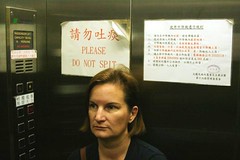 Lifts stops at ever other floor, odds or evens. People queue for the appropriate lift, which is tiny and often one opts to take a lift to a floor higher and walk down. A ‘car full’ sign lights up on the descending car to pre-warn that the door will not open at that floor. I heard that on Hong Kong Island there is not enough square footage for everyone to stand outside at the same time, since so much of the population is stacked up into the skyscrapers.
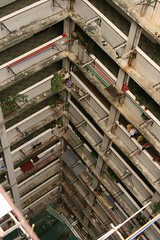 measured 7×8 feet. The bed took half the space, the bathroom another quarter. We had to keep one pack under the bed and only one person at a time could stand in the remaining space. It was $31(HK$250)/ night, or about 50 cents/sq.ft.
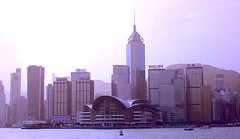 Rain greeted our arrival, and socked-in dense clouds ruined our skyline photo opportunities. Socklessness was fine but my t-shirt warm wasn’t enough. After a day and a half of our planned 3 day visit we found the Cathy office and bumped our departure up one day. We were burning through $75/day and definitely not living large. That kind of cash in Bangkok would get you luxury, so off we went.