
Nepal: A Little up and a Little Down

No more Royal Nepal Airlines. They were a joke anyway, with the king often commandeering one of the fleet’s two 737s for a skiing weekend in Switzerland, or some diplomatic junket, and leaving the scheduled passengers high and dry. Now a republic has been declared, and the king is cooking his dhal in his palace by candlelight, since the democratically-elected Maoist government cut off his electricity over unpaid back bills and froze his assets. Now it’s just Nepal Airlines.
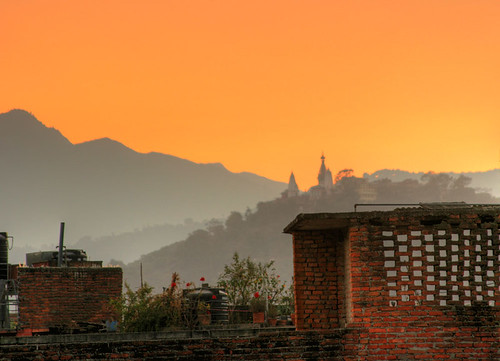
 The flight path from Bangkok to Kathmandu hasn’t changed; nor have the mountains. I glimpse Cho Oyu, and Everest, tinged pink, floating over the darkened plains. With political stability- in a relative sense- life in the capital has returned to normal. But the normals of Kathmandu, to paraphrase Kipling, are the wildest dreams or Kew. Without a blockade there is no fuel shortage, and with no fuel shortage, there is no car shortage. The 7 km from the airport takes an hour, accompanied by much hopeful honking at the congestion, which is often so tight that pedestrians can’t even squeeze by. Downtown, in Thamel, the activity is as frenetic as ever, and the prosperity of the shops can be judged by whether they have lights – and therefore a generator- or candles, as this is the beginning of the “load shedding” season. We stay just outside of the hub, where candles are much more common. Since the only light on the street comes from the vehicle headlights, walking takes on a phantasmagorical property – figures coming towards me are backlit silhouettes, disappear as the beams swings into my eye, and reappear as schoolgirls, goat-meat venders or
  itinerant shamans, whatever the case may be. For the bicyclists who speed downhill -without a light of course – the effect must be absolutely hallucinatory.
The economy is up. Despite the global meltdown, Nepal has seen more foreign arrivals in Oct. since than at any time since 2000. Prices are up as well, our visa, the taxi in, and our room all jumped by 20%. Our jeweler, Malik, is happy about the upturn, but even happier that stability means he doesn’t have to pay off both the police and the Maoists. Last year he was on the verge of despair. Much of the ten days we spend in Kathmandu we spend with him, meeting his workers, placing our orders, drinking tea and visiting. Last year we had an assortment of his beads – among other jewelry – and the interest was such that this year we have far more. Malik specializes in traditional Tibetan work – coral, turqu oise and shell inlay with brass and silver. He often works with designers on reproductions and variations, and is happy to use electroplating or substitute white metal or “pressed” stones if price point is an issue.
We also make contact with our other established contacts. Pragati and her father still operate the world’s smallest small business, wh ere we buy bags made from recycled rice sacks, in a shop in the old city so tiny I cannot even sit down inside it. Sitaram and his crew of hipsters smoke cigarettes and put images from Hinduism and Buddhism on just about anything they can – we buy posters, fridge magnets and mouse pads. Raju has branched off from the family business selling old and new antiques, and now has a little corridor with wooden masks and sculptures. His father, Narayan, still has the big store, and compounds the fairly sinister effect of room upon dusty room of old jewelry, rows of fetishes, tantric ritual paraphernalia and memorial figures piled like cordwood, by following close behind you with his one milky white
  eye. On the downside, two people we felt a strong connection with are gone. Namgyal Lama, our shipper, who has always had a twinkle in his eye, and was known to the community as ‘Foxy’ for his wit and smarts has died of cancer; and Kasang who ran an antique store within the compound of the Bouddhinath Stupa was unable to survive the last year and is out of business. Malik told us the Chinese had recently stopped granting visas for non-resident Tibetans wishing to travel there, and this likely finished Kesang’s business off. We will miss them both. Another institution we will miss is the inspiration for this blog’s title. In a small alley in the old city was a grungy café and restaurant with no door except for a curtain, selling the usual Tibetan fare: momos, thukpa, chowmein. It was called the Up and Down, and we always joked it wasn’t topography but business that the name was referring to. Alas now it’s a little down and out.
Our guest house owner, Yves, a French national married to a Nepali woman is also relieved with the new normal. Last year he was truly worried about their future, and now, this time, we got the last room, and although it was load shedding hours, he now had a new generator furnish some light. The weather also was more up then down for us; enough sunshine was available to heat the solar-powered shower water to close to a comfortable temperature. Not once did Katheryn bathe with a down coat on, though it was a little too cool to bathe daily. The effects of wild market swings caused the foreign exchange rates to fluctuate, daily a little up or down, though on average we got as good as rate as last year.
One institution that has survived is the world’s strangest wine shop. It’s facade is wood shutters and old-world beams , but it is set into the featureless fortress-like wall of the American Embassy, and it’s roof is lined with motion detectors, search lights and rows of razor wire. Inside the staff is very genial, and we buy bottles of ten year old French wine for $6, and as a real treat, Caol Ila single malt Islay for 25% of what it costs in Vancouver.
 We have a bottle of each in my pack as we head out of Kathmandu early in the morning for Bandipur. Newari merchants built Bandipur into a flourishing town two hundred years ago, on account of its location, straddling a ridge on a major trade route from India to Tibet. It continued to prosper until the ’50s when the new Paithri highway was built in the valley; then suddenly the town, the richly decorated temples, and the stone mansions with their carved balconies, became redundant. Taking a progressive approach the Nepal Tourist Board identified Bandipur as a place to practice cultural and ecologically-sensitive tourism, and development has preserved much of the town’s
  character. A Tibetan yak drover for instance, would feel quite comfortable in the room in the old mansion that we find. It’s true, at 6’4″, I’m of somewhat different stature from the locals, and for much of the two flights of stairs up and down, the back and forth to the outside toilet, and walking about the primitive room or lying in bed I’m hunched up trying not to hit my head.
Traffic isn’t permitted on the town’s flagstone main street, which itself is incentive to stay another day.  A short walk away is the old market and assembly area, the Dhulikhel, now a dusty flat ground surrounded by ancient banyan trees with an impossibly majestic view of the Ganesh Himal and the Annapurna range. It’s Saturday, the day off at the local girl’s school, which also attracts busloads of boys from the valley. They all gather at the Dhulikhel to mingle, play music, and have picnics and party. We fall in with a group of ravishing girls led by Shushima who give us flowers, practice their English, and call after us “Kat- a-rin, you are
  beautiful!”.
We made our way up to Bandipur in a shared jeep with the usual cluster of men hanging off the back. We go down in a local bus, which should be more comfortable, but in fact the seats are so close together even the locals can’t fit in them properly. Back down in Dumre on the highway, we flag another local bus to take us to Pokhara, 64 km away. The journey ends up taking three hours, and for much of the trip I have a goat prone at my feet, and another standing by my seat who insists on putting her head on my knee,  and at one point, reflecting how many of us feel, pees on the floor.
Pokhara is a small comfort station on our journeys throughout Asia. Its location is idyllic – on a lakeside beneath the archetypal sacred peak of Machchapuchare, Daulagiri, and the Annapurnas providing a backdrop, and at 800 metres enjoying the near-perfect climate of bananas and  bougainvillea. Yes, there are scads of tourists, but there is also such a plethora of accommodation and services that we can find a lovely picture-window room with said vista for less than ten dollars. It is easy to wile away the days doing nothing but sampling the restaurants between morning coffee and evening scotch. It is too easy. So we go up the biggest hill we can find. The little village of Sarangkot sits on top of it, and is a popular place for paragliders to launch themselves off of. And if you need one more superlative view of those endlessly – photogenic, gigantic peaks, this is
  it. This is also our last high point. It is downhill all the way to India. The descent begins with a long, long, staircase to lakeside. It is a challenging path, and we are going down. Coming up is a woman of about our age wearing flip flops and carrying a load of wood on her back in a basket. She drops her tump line beneath the same tree we are resting under with a loud snort. Sharing neither a reality nor common language we manage to communicate enough to share our biscuits. When we complete the descent, our legs are quivering.
Tomorrow is another bus.
Check out more photos by going to our website https://www.kebeandfast.com and click on EXPLORE on the menu bar.

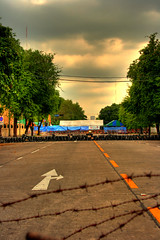 the PAD activists took control of one of the major streets lined with government offices, and barricaded themselves in with sandbags, tires and barbed wire. They are still there, and yesterday Katheryn and I went down to have a look.
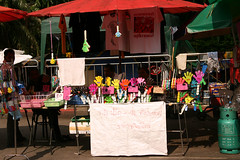 barricade. As we approach, loud music is pumping from a truck on which is painted “MURDER Bring the Killers to Justice”. A very pleasant young man apologizes that he has to search my bag, and then we are in. After the dour menace of the police side, it is very much like a carnival. There are loads of little eateries, the streets are lines with pavilion tents selling political merchandise, and there are at least three places I spot where you could stop for a foot massage. The hot ticket this oust-the-prime-minister season is the hand clapper. They started showing up at rallies in the spring – two glove-like hands on a stick that make a great clackity-clack when you shake them – and now they are a must-have for
  every demonstrator. Stomping on Somchai’s face is another popular theme, with his visage adorning flip-flops and bath-mats. And of course there are the T-shirts. Unfortunately the vendors here cater to a local crowd, so there are no XL sizes for me, and Katheryn doesn’t wear yellow (the PAD party colour), so we don’t buy anything. The sentiments, expresses as only T-shirts can, range from anger to resentment, with a smidgen of hope that the year 2551 will bring peace and change.
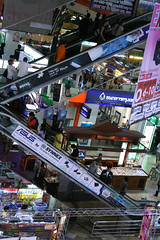 crown, which is much cheaper in this Kingdom than it is at home. Another thing that is cheaper is software, especially at the notorious Pantip Plaza, five floors of shops dealing with everything computer. I pick up a program that allows me to blend three different exposures of the same photo into one picture, making an HDR (High Dynamic Range) image. This lets us take pictures of high-contrast scenes, parts of which would previously have been over or under exposed, and produce some amazing results. Please bear with us while we indulge, and check out some of the pictures on our flickr site.
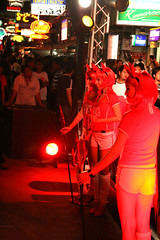
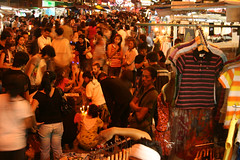 The friend thought a second. Is it an animal? So not having deep cultural roots, Halloween is just an excuse to party, which last night on Khao San Rd. is what everyone was doing. And then what happened? At around 10, just as the crowd was getting really thick, the thunder crashed and the lightening flashed and the sky finally opened. Everyone got soaked, but the party kept on going.
 The final leg of this year’s epic journey is destined to be Northern Thailand and Laos. We haven’t been to Laos in 2 years and we decide to go in easy stages to our ultimate destination, the 700 year old town of 20,000 people, Luang Prabang. We have an easy, comfortable train ride from Bangkok to Udon Thani in 9 hours. Unfortunately the double-pane windows are smudged and covered with decades of dirt, and even though the line passes through some dramatic scenery, we couldn’t see very much. In Udon Thani we got a fantastic cheap room with all the mod-cons. There seemed to be a fair sized ex-pat community living in this nondescript by likable northern city. From there the next day we took a short one hour bus to Nong Khai, the border town, with Laos just across with the Mekhong River. It’s
 star attraction is a very unusual park created by a spiritual leader named Luang Pu. He was a Lao who fled to Thailand when the communists took over in 1975, and he sculpted in concrete and supervised the making of colossal, bizarre images of Buddhist and Hindu deities, fashioning them in totally unconventional and often disturbing ways. The park is called Wat Kaek, and though he has since died the
  work is still ongoing. The faces, which are often 10′ high, characteristically have a blank, plastic quality that reminds me of Odo from Star Trek. One impressive statue is a 90′ high Buddha sitting under a very evil-looking 5-headed naga whose protruding fangs and tongues create an image a little removed from the benign teachings of the middle path. Still, it’s enjoyable in a very “Burning Man” kind of way.
 you have a lot of them.
 from the garden. We enjoyed these while watching the local kids leap into the river from a rickety bridge.
 everywhere. We take a very pretty room at the Cold River Guest house, with a view from our balcony of the garden, forest, a massive bamboo, and the Nam Khan, a tributary that feeds the mighty Mekhong. It feels good to have a place to stay put for a while; we have had been in 5 hotels in 5 days, a first this trip, but quite normal other years. Our hotel ,though lovely, should have been called “No water.” Due to its own pipes and town problems we often have no water, which is excruciating in the 35 plus weather with heavy sticky humidity. The hotel is favoured by Japanese travellers, who are very friendly. One evening they are sitting around and invite us to taste some local alcohol they have bought. Inside the bottle there is a dramatic cobra with it’s hood extended, biting into a large scorpion. No really, pickled inside the bottle! David, the fool, immediately said yes! He said it tasted like brandy.
 Shopping is our main reason to come here. We have a delightful source of hand loomed scarves and shawls, Phonsavan, and go to see her in the morning. We make our choices in a few hours and set about photographing it all on locations that say “Laos”. Though it was stinking hot, and we were soaked with sweat, we got terrific shots of the shawls, in temples and on old colonial buildings.
 smoke, and the sun always disappears well before it reached the horizon.
 over Buddha statues and poured gently over the palm of an elder. Nowadays huge coolers full of water are dragged to the curbside and hoses are brought out to soak the motorists and everybody who passes by. People sport pump action super-soaker water guns, and make a water war of all the streets. The enthusiasts in Luang Prabang start celebrating it 5 days before it is scheduled. When we had the stock with us and the camera it was a pain. But after that we are more likely looking for the soaking to cool off. It is actually quite a hilarious festival.
 4 days ago. We did find a decent room at a fair price, facing the now-unused airstrip the Americans built to conduct their illegal carpet bombing of the country during the Vietnam War. It seemed great until we saw the stage and tables and speakers being set up for the town’s celebration, almost in front of our hotel! The prospects for a good night’s sleep were looking grim. At least we had air-conditioning and it was stupid hot. But the party down the street used so much power it blew a fuse and blacked out our part of town. No more air-con. We opted for a mint-lemon juice and went to dinner, but following the theme of the day, they forgot one of our dishes. Things were just not going our way. But miraculously, probably because of the town-wide blackouts caused from the giant P.A. systems, the party didn’t go all night and we got a decent night’s sleep after all. We took a 7 am public bus to Vientiane, learned the long distance bus to Udon Thani was full, and decided to go south piece-meal. At every turn, with the festival in full
  swing, we were faced with inflated prices and constant bombardment with water. In Udon Thani the hotel situation was dire as well, but David, the world champion hotel finder came through, thoroughly soaked, but still grinning.
 A week in Borneo is K’s birthday present. As most of you know, she has a long history with monkeys. But an ape she has never met. There are only two places on the planet where the great red-haired men-of-the-forest, the orangutan, live: one is Sumatra; and the other is Borneo.
 store. She is a slim energetic blonde, and she and Peter are making plans to go to Burma together. In amongst this social action we also get together with Boris, our French ex-pat friend living in Bangkok. Unfortunately, Boris isn’t too keen on Thai food; but this is one of the most cosmopolitan corners of the universe, and we choose to eat (admittedly very good) falafel in a back alley place. Later Boris takes us well out of our usual stomping grounds, across the river to Thonburi where Bangkok still feels like a small Thai town, and then far to the southern edge of the city where a market sprawls along a network of canals.
 large, Frank and Kerry are full of fun and generosity. Frank was just back from Bombay when we arrived, where it looks likely he will be setting up an office for his company. The evening started out with wine, and wine kept flowing well into the night, as Kerry, a dedicated Chelsea fan, was staying up anyway to see her team take on lowly Barnsley in the F.A. Cup. The wine in this case was probably a good thing, as Barnsley stunned the football world by beating the powerhouse London team.
 What we get is a dormitory-sized room with smoothly polished hardwood floors and a view of a Chinese temple, a furnished balcony/sitting area, and a fully equipped kitchen. It is actually larger than our apartment, and would be a great place for a party. But there are stern signs demanding SILENCE, and a set of rules stapled to the door including an injunction against “merry-making”.
 Orang Ulu people.
 It’s a good thing we weren’t expecting an intimate wilderness experience, as the parking lot is full when we get there. However, there are orangutans in the trees, and they are so beautiful and rather quizzically philosophical about it all that it is easy to ignore the people. The old matriarch Delima is the star of the moment, with her youngster, Selina, clinging to her back. She is sitting on the ground a dozen feet away, deciding whether to dine at the smaller but closer platform in this clearing, or at the main feeding station 500m away through the forest. She opts for the forest feeding station, and she chooses the public path to get there. The park staff are frantically calling to people to get out of the way, “she is tempermental!”, as she lopes off purposefully over the foot-bridge. It is a covered bridge, and on its walls are pictures of Delima when Selina was just a wide-eyed muppet. The baby is now 3 years old, and Delima’s face is more lines and tired. It’s no wonder that she gets grumpy.
 over-head cables. He shimmies down the tree to the feeding platform head-first, reaches an impossibly long arm out to select a bunch of bananas, transfers them to his right foot, and turns himself around to climb back up the tree, bananas in his toes, all without a slip, a sound, or a strain. Then he dangles himself in mid-air holding the cable with his right hand and right foot, and has breakfast.
 forest, and for reasons of his own wants to have a good look at at his odd primate cousins. He settles into a tree right beside the path as we approach. His eyes are dark deep still pools. He is calm, and un-threatening, and although most people have stopped I continue walking past him, within a few feet, in as relaxed a manner as possible. K., I know, resists the temptation to invite him to house-sit in Vancouver (or alternatively join him off in the forest), and we walk back out of Semenggoh, satisfied with out experience.
 Kuching.
 have seen numerous macaques, a bearded pig, monitor lizards and two beautiful, chartreuse, diamond-headed vipers. A short afternoon hike out to Teluk Paku takes us through jungle like jungle was meant to be. The air is as hot and humid as a sauna, and so fresh it feels as if we are breathing pure oxygen. Small streams bubble out of black caverns, tree trunks rise straight and smooth into an unbroken canopy, and creepers and vines cover everything. Up above us in the tree-tops there is a rustling sound, and we spot one of
  Borneo’s unique and famous citizens, the probiscus monkey.
 the water has perculated through the loamy underbrush, and is the colour of dark tea. K is somewhat reluctant at first to go into the opaque, unfathomable jungle-lines pools, but I am too hot to care, and plunge in.
 Then, however, we get in a boat, and then a bus, and then a taxi, and then a plane, and then we are in Penang, and then next morning we catch another flight and we are back in Bangkok. All of a sudden everything is completely different. But this is Bangkok, and it is where trips begin.set:72157604327549665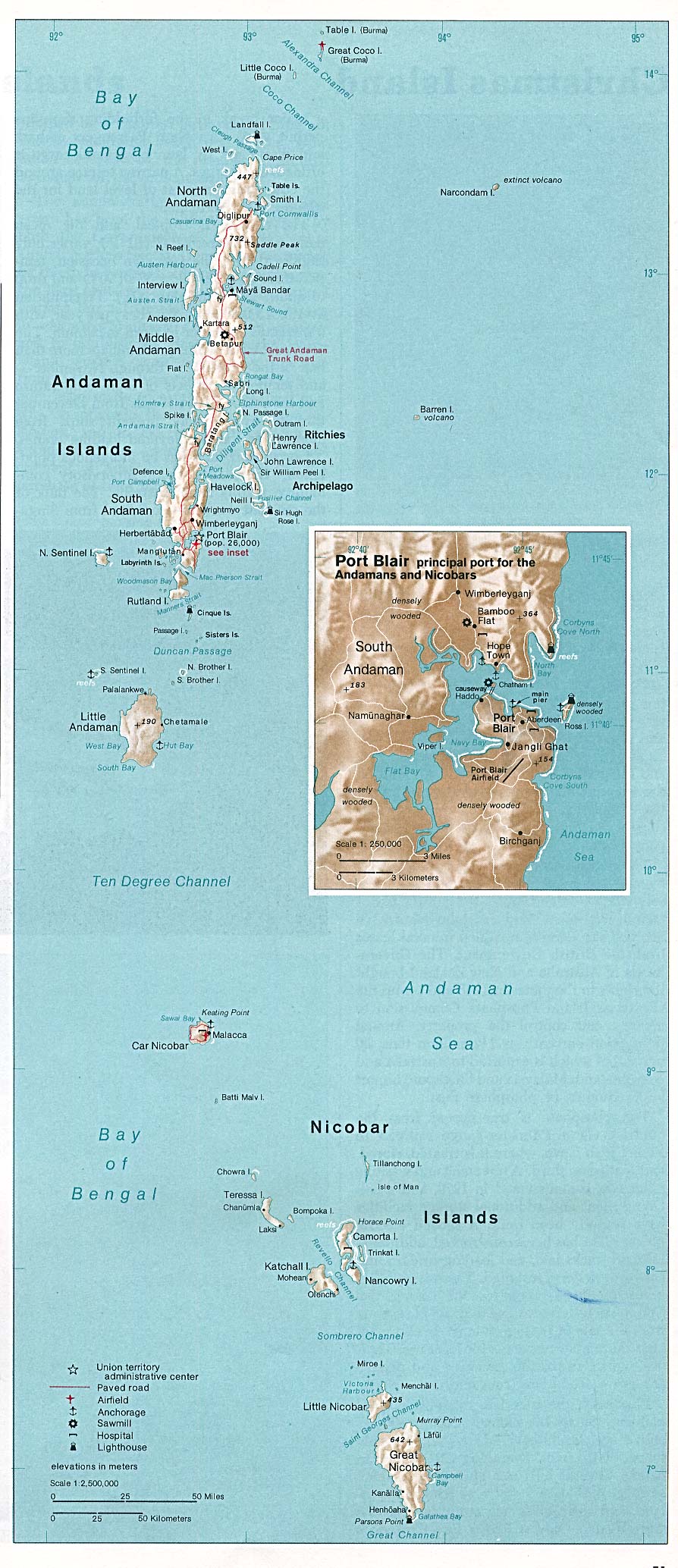

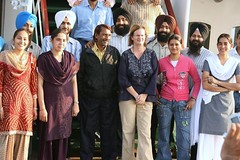 captain was from the same village as some Punjabi folk dancers en route to a dance festival in Port Blair. They, and 3 other groups, were invited to use our deck to practice, then on the final night, a formal performance was arranged with full costumes. We dressed up for it, like you should when one finds oneself at sea.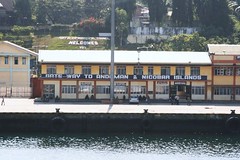
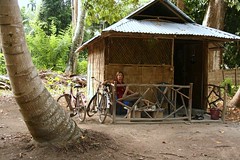 concrete bathroom floor, comfy bed and pleasant coconut grove garden for 400 rupees (about $10) at El Dorado. The plan was to stay on as long as were we happy. After a few days we managed to score the hut nearest the beach. At sunrise, through the split bamboo, magical little beams of light danced everywhere. We heard birds, crickets and frogs along with the lapping Andaman sea while lying in bed. We stayed three weeks. There was an array of wildlife incidents in our bungalow. We had a small black scorpion that David shook out of his shorts before putting them on. A large cockroach and similar sized crab both took refuge on our soap dish,
 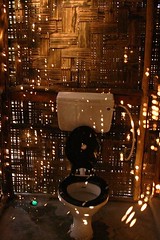 though not together. The bamboo bathroom wall could never dry out so there was a slight but ever-present aroma of mold, and every few days a tiny clump of gun-metal grey mushrooms would crop up at the bottom of that wall, but would be efficiently removed by the tireless army of ants. Sitting on our balcony at sunset, without fail, we would greet a passing frog, no doubt on his ancestral route past the right hand corner of our cabin. Surprisingly though, sitting on the balcony as night fell, our light attracted nearly no flying insects. The daily presence of fine saw dust under all the bungalows beams, showed evidence of another tireless insect colony, which would likely eat the whole cabin within a year.
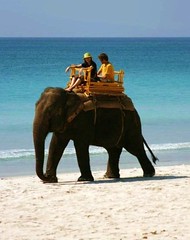
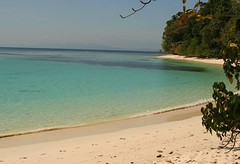 fine clean white sand. Simply extraordinary. Twice, while standing by the entrance to our beach, a newcomer would try to say hello, get their first glimpse of the colour of the water, and not be able to say hello, because they had to say ‘wow’. The lack of pollution was astounding, unprecedented in my trips throughout mainland India. A solar plant provides some of their power needs and we never suffered long power outages. Internet access was very limited though, and even phoning was a problem at times. It felt nice to be unconnected.
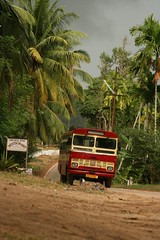 on the opposite side of the island. Our bus, for pennies, dropped us in town (the mid island’s Village Number Three) just 5 minutes away, where we’d have time for a roti cannai and chai breakfast before our second bus arrived. It would take us past the teak and thatch homes (or sometimes cinder block and tin), past rice paddies and palm forest, past dense vine-heavy jungle to the finest beach we’ve ever seen, called, prosaically, Number Seven. If you don’t believe us, Time Magazine called it the world’s best beach in 2004. It was a half an hour walk from the bus to the where the snorkeling was best, on a path through a mature tropical hard-wood forest (including the Giant Dum Dum trees) with jungle-covered hills on one side and the azure ocean on the other. The trees were tall and straight, with silver-smooth bark that looked like dinosaur skin. The bottoms often sported wide buttresses, and high, high above our heads the tree tops resembled broccoli bunches. Magnificent mighty trees, and given the scale of the
 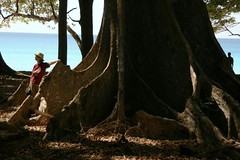 logging over the last century, shockingly still standing. Port Blair once had the biggest saw-mill in all of India, and only 10 years ago did the cutting stop. That this century-old hardwood forest with such easy access on a beach-front never got axed is a miracle. The snorkel beach provided shade, had wonderful fish and okay coral. The most impressive of the fish were the Napoleans. About 50 of these massive coral-eaters stayed fairly near shore, very unaffected by our presence, solely interested in munching the hard coral. You often heard them before you saw them, but with a large bump on their head and weighing in at about 40kg each they were quite the sight, especially since they had no fear or interest in swimmers, and we could be literally moving right among them. A myriad of other tropical fish were seen and of course the thugs of the ocean, the barracuda. On the beach there were no bars, no venders, no music, no jet skies,
  no beggars, and no tourist boats pulling up dropping off groups. There were only ever a half dozen people there. No kidding.
  frequently enjoyed at one of the ‘meals ready’ shacks, a rice thali for 50 cents, by the bus stop at Beach Seven. Beer was the same price everywhere, 100 rupees, even at the gorgeous open air Italian restaurant overlooking the beach, so naturally it became our ‘local’ for our ‘sunset beer’. This simple and pleasurable existence was easy, finding ourselves saying frequently, with emphasis,” this is really nice.” It was a breezy 32 degrees everyday, low bug issues, good transportation. We had so many friends we’d sometimes even avoid people. We both turned the colour of Macintosh caramel and neither of us burned (too much) or got eaten by a shark. We didn’t even see a shark, except on the menu.
 Island. By development, I mean it has 3 guest houses. The situation for buying a boat ticket was, again, the only part of the whole place that reminded you that you were still in India. Because there was a ‘women’s queue’ I stood in the throngs for hours struggling to keep my place, pushing and throwing insults just like the next in line, a tiny, sari-clad ruffian. The majority of the tickets are sold for triple the price on the black market to tourists at their guest houses, and after a four hour wait for the window to open, only 4 people were served before they closed it. I persevered and secured us passage but had a smoldering feeling of violence that affected me all day and even seeped into my dreams.
 you can swing it, GET THERE NOW. THIS IS ONE OF THE LAST GREAT UNSPOILT TROPICAL ISLANDS.
 than a train station, and we alight under the big palm trees in front of the GPO.
 obviously had some pedigree in his past, perhaps Springer Spaniel, but who now scratched his fleas like everybody else.
 and the preserver, half-hidden in the shadows in the back.
 their pictures taken by cell phone in front of the Trimurti, the cave is brooding and evocative.
 We have been in big Asian cities for the better part of 2 months, and I have read of a place near here, Champaner, a UN World Heritage site, that sounds like it might be nice and rural for a change.
 The ruined mosques are from the 15th and 16th C, and are notable because of the strong Hindu elements found in them.
 whether the stones and pillars were harvested from existing temples, and modified to avoid any iconography; or whether the rulers were so far out in the Hindu hinterland, so far from the mainstream of Islamic convention that they were “going Native” – we were unable to find out.
 ruined mosques.
 selling vegetables and hunks of goat in the dust by the side of the road when we get off, and direct us out of town with a wave of the hand.
 never been on anything this crowded.
 beautiful works, however, are the mosaics, done in an Indo-Byzantium-Romantic style executed in gold tiles.
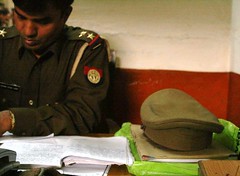 We apologize to our concerned and faithful readers for not keeping up to date with the blog. There are at least two reasons for this. One is that an unfortunate incident occurred on the train from Delhi to Varanasi back on Jan. 2. We had just boarded and were settling ourselves into our compartment, and chatting with the couple we were sharing it with. They had a 2-year-old who was doing an orangutan imitation, and a valise that was the size of a small car, and so in trying to move ourselves and our luggage in, we put a small shoulder bag on the top bunk. More commotion ensued, the conductor came, an empty neighbouring compartment became available, and in the process of moving our gear over we noticed that the shoulder bag on the top bunk was gone.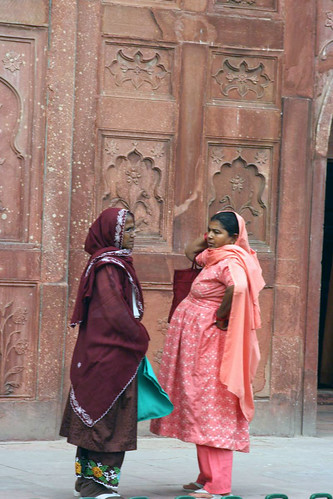
 bliss, since most of the year they endure +40 and dust, but we whine and pull on our down jackets. What Delhi has become for us is a production center. We make 3/4 of our bedding here now, dealing with Deepak, who has a small but modern factory with good light and new sewing machines, swatch books and numbered dye-lots. In the same neighbourhood is the husband and wife team of Parminder and Amrita. They know everything about scarves, and expose a lot of the myths that we have been fed from other less-reliable sources. Silk cotton viscose rayon and all the varieties of wool… there are some
  very good imitations and unscrupulous dealers out there. Within the environs of Delhi and the neighbouring Punjab is where much of the post-handloom production for these goods takes place, and Parminder personally oversees the patterns and fiber content of his scarves. One of the most beautiful things we find is a woolen shawl with Kashmiri embroidery. These are still made by hand in Kashmir, and they are amazing, and they cost a fortune. The ones we buy are Punjabi-made, and although the embroidery is done with a machine, it still is the result of the skill of the worker using the machine, and is hardly less impressive. An embroiderer makes 320 rupees/day, compared to the minimum wage of 150 rp, and it takes 2 1/2 days to do the most ornate shawls. A hand-embroidered shawl of the same complexity takes a month. We also find some fun things, like the classic Delhi carry-all, the recycled
 advertising bag. These were originally made to promote everything from toothpaste to Bollywood blockbusters, and are the everyman’s bag in this city.
 work for our wall hangings. Then we found Kishor, in Jaipur. Kishor’s family is from Sindh, in southern Pakistan, and was displaced during the disaster of partition in 1947. His grandfather was in the textile business, and they moved to Barmer, across the border in Rajasthan. We also went to Barmer, hearing that it was where much of the embroidery comes from. It turns out that this is like going to Saskatchewan to buy bread because that is where wheat comes from. The embroidery certainly passes through Barmer, some of it local, some from Gujarat, and much, now, from Pakistan. But it
  filters through all the villages, and very little can be found in any one place. Dealers like Kishor and his father buy it from many sources, and then are able to amass a reasonably good selection. Once again, the rapidly changing times in India are evident: much of the best Indian tribal work is getting harder to come by, and is being replaced by characterless modern embroidery. The best stuff now comes from Pakistan, from Sindh and Baluchistan, and we find some wonderful pieces at Kishor’s.
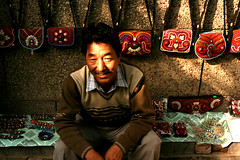 separate shipment, and the costs multiply accordingly. If we come across a local artisan producing treasure, we have to carry it out with us in our luggage. Sometimes we just can’t pass it up, as with Topkay, the Tibetan gentleman who sits at the corner of our alley everyday beading bags. Fortunately, Parminder agreed to do us a favour and include Topkay’s bags in his shipment (for a price, but that was reasonable), and we put
  in a sizable order with him. Topkay has been at his corner everyday we have been here, but the day after we payed him he wasn’t. I hope that with the little windfall we gave him, Topkay took a holiday.
 live at Scindia ghat, which is to the east of center. In front of our window is the leaning tower of a temple too heavy for its foundation, now picturesquely subsiding into the river. From our hotel we walk down a dark flight of steps, and as soon as we set foot on the ghats above the temple someone yells “Hello! Boat?!” It is a greeting we will hear several dozen times a day, touts trying to take us for a ride on the river. A few steps along and we are at the wood piles of Manikarnika Ghat. This is the most auspicious – and expensive – place to be cremated. Big scales weigh up the logs for each fire. We take an archway to the left, and descend almost into the yard where the bodies are burned. There are always five or six pyres on the go. I have seen this scene many hundreds of times, as have most people
  here, and there is very little overwrought emotion on display. All the same it is a peculiar place. Dogs find relief from the cold and their itches by curling up in the warm embers, and sometimes a naked holy man will bathe in the ashes of a dead fire, covering himself from head to toe as a graphic expression of the impremanence of life. We skirt the top of the burning grounds, and return to the river’s edge under the palace where our friend Pappu lives with his family. The palace has been abandonned and unkept for generations, and Pappu, a kind but down-at-the-heel Brahmin I met years ago has as squat inside. Charming as they are, the ghats are filthy and smelly, serving as a toilet for dogs, people, cows, water buffalo, and all the other creatures who have nowhere else to go. A little way along the ghat is wide enough to play cricket on, but I always wonder: who gets to fetch and clean the ball, or do they just keep bowling crap?
 but primarily it is a big laundromat. The water is a turgid brown, and knowing what goes into it I recoil from even getting my sandals wet, but scores, hundreds, thousands of people are scrubbing frothy masses of clothing in the river, and while their knickers are drying they brush their teeth and lather up and kick around for a bit of a swim. Either the hospitals are filled with ulcerous cholera patients, or there is a God.
 our business, we decide to keep going. Right beside the main ghat, the Dharbhanga and the Maharana have some beautiful palaces, but from there things decend out of the tourist-pretty very quickly. The Harischandra ghat and it’s environs look more like the water buffalo bathing ghat. This is another cremation ground, however, the poor relative of the Manikarnika. There is no fancy temple here, just a mud flat where the bodies are washed and burned surrounded by wallowing livestock. Beside it, the Dandi Ghat has attracted some pretty strange tenants. There are holy men, sadhus, all over the city, and dreadlocks, ashes, face-paint, robes or lack of them, pet snakes, drums, skewered lips, hash-filled chillus don’t usually attract my attention, especially as there is often a pitch for money involved. So walking by the makeshift tent I barely glance in, but Katheryn says: they’ve got a human skull!. I know it’s bad manners, and I don’t usually take pictures of people with human skulls
  without asking, but this time I sneak one, and get out of there quick. This is India, and there are no solitary occurances, and a few yards on the sadhus have FOUR skulls on a mat in front of them. This time I ask for a photo, and the answer is no.
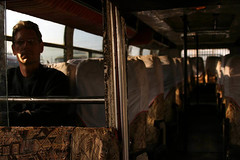
 We turn off the highway and find ourselves on an elevated, single lane brick track, more like a drainage dyke than a road, running through the countryside. With rice paddies on each side we bump along in a cloud of dust about 10 feet above the fields. Ironically, the bricks in the road we are following are yellow.


