 Another arrival in Bangkok, and another new Prime Minister in Thailand. It’s getting repetitive. This time the new leader is Abhisit, and the difference is that he is from the side of the yellow shirts with the hand-clappers. These are the people who blockaded the airports in Nov., and his selection should mean an end to paralyzing protests in Bangkok. Now it is the Red Shirt party with the foot-clappers who are disgruntled and it remains to be seen what kind of pressure and disruptive tactics they will be able to exercise.
It’s always a relief to be back in Bangkok, but our unfinished business from India continues to dog  us. I didn’t want to leave India before our orders were completed, and packed, and sent, but the assurances we received from our suppliers have repeatedly turned out to be misleading, and things are starting to fall far behind schedule. The astrologers promise all that will change. We are on the cusp of leaving the fiery Rat Year, in which things are bound to go haywire, and enter into the stable, if un-dramatic, Year of the Earth Ox.
The place to be for Chinese New Year in Bangkok is Yaorawat Road. Yaorawat is a blaze of neon signs advertising its two famous businesses: restaurants which serve badly, badly incorrect food such as sharks’ fins and bird nests; and gold dealers. I expected it to be busier. Even the shrines and temples on Yaorawat and in the surrounding alleys are conspicuously quiet. Partly this is bad timing: it is mid-afternoon the day before the biggest celebration; and partly
  it’s the economy. Many businesses are doing poorly, and the price of gold is so volatile that for the first time ever, on the Sunday that the markets are closed and the merchants can’t get minute by minute updates, the gold shops shut their doors. Despite this, it is colourful and crowded, and strings of fireworks are going off, and in a striking parody of the world-wide government rescue plans for the economy, piles of worthless paper money are being burned on the street.
Back down in the tourist-ghetto of Khao San Rd., three elephants and a troupe of lion dancers are competing for the attention of a small forest of photographic equipment. The announcer for the elephants is trying to generate excitement: ”This is the first time three elephants have ever appeared together on Khao San Rd.!” he shouts, and the elephants, giving the people what they
  want, stand on their hind legs. Even so, they are getting stiff resistance from the dancers, who have drums, fireworks, lions, and a spectacular 10-man dragon who solicits donations in its jaws from the shop keepers. I position myself for the real event: when the dragon entourage meets the elephants, who, freaked out by the noise, will charge wild-eyed into the sea of spaghetti-strap tops and zoom lenses. Fortunately (I guess) , when the fateful moment occurs the elephants remain aloof and detached, putting it all down to just another day of degrading work for The Man. And what do they get for it? Just peanuts

LAOS: SLOWLY UP AND DOWN THE MEKHONG
Laos is a wonderful country; so far I’ve only met one person who didn’t like it, and he was Austrian, and bitter. Usually we justify a few weeks here by traveling up to Luang Prabang, and  buying as many hand-woven scarves as we can carry from our friend Sukhsavanh. Laos is entirely landlocked, with a long, relatively-skinny neck in the south supporting a star-burst head in the north that reminds Katheryn of the profile of Side-Show Bob. The star-burst head part has the topography of a crumpled ball of paper, and is stunningly beautiful. The long neck follows the wide vein of the Mekhong River, with the eastern border being a spine of mountains separating Laos from Vietnam. In previous trips we have crossed through Savanakhet and Lak Xao in the middle of the neck, coming and going from Vietnam, but we have never been in the far south.
A 5:45 am train from Bangkok gets us effortlessly to Ubon in eastern Thailand by 2:30 pm. The plan is to do it the easy way, and take the last “Friendship Bus” of the day at 3:30 straight to Pakse, Laos, in time for a cold sunset Beer Lao on the Mekhong. Within moments of leaving Ubon station, the plan has gone awry. I am expecting some motorcycle-based form of taxi to take us the ten km to the appropriate bus station. Instead a lanky cowboy solicits us, and agrees (too readily) on a good price and hustles us out to his pick-up. A few minutes later we are at a place where transportation leaves from, but it is definitely not the station I had clearly insisted on. Its a songtaew stand, home of the very-local pickups with two wooden benches in the back for passengers. There is a lot of commotion, and negotiating, some recriminations, and finally we accept that resistance is futile, and we are crammed into the back of a songtaew heading to some place half way to the Laos border. There we are met by a larger, rougher vehicle doing the next 40 km to the frontier at Chong Mek. This is a 5-ton truck with wooden benches, and its
  excruciatingly slow. Still, the locals are friendly, and school kids are riding on the roof, and eventually it get us close enough that we can walk the rest of the way to Laos. As it turns out the “Friendship Bus” and its load of much smarter travelers then us arrive just as we check through immigration, and I am able to slip the driver a few baht to take us the last 40 km into Pakse.
Pakse has the last reliable and affordable communication with the rest of the world that we will have for some time to come, and we have to stay a couple extra days making phone calls to India and sending off emails done in caps lock titled URGENT RESPOND IMMEDIATELY or some such variation of attention grabber. When we are satisfied our goods have been set in motion we head south to Champasak, a small town 30 km away on the other (west) bank of the Mekhong.
Back in the time when huge snake-kings ruled in under water realms below the river, a prominent natural rock formation on top of a mountain here was believed to be the linga (penis) of the god Shiva. Even before the Khmers to the south were building Angkor Wat, Champasak was the capital of a powerful Hindu kingdom. Nothing is left of it now except for one extraordinary temple, now a ruin, from  the 10th C.
Lovely hand-built ferries ply back and forth across the river. The smaller ones take motorcycles and passengers, and the largest, like the one our songtaew is on, can hold around 6 vehicles. Boarding and landing is done straight from the beach, with a couple of heavy planks the only help for drivers on the sandy slope. The modern village of Champasak, 8 km from the temple, is a charming little place. Almost everything is spread along one paved road beside the Mekhong; whatever didn’t  make it there is on a parallel dirt street. At the center of town is a forlorn fountain, which hasn’t worked for decades, the project of a governor whose grand mansion was also never finished, and is now a sprawling ruin on the dirt street a block away. Maybe this is where ambition goes to die, but it certainly doesn’t bother the owner of the Vong Paseud guest house, where our songtaew drops us. His contagious good nature earns him the nickname ”Mr. Smiley” and his open-air restaurant right over the river is the ideal place to relax with a Beer Lao in the evening. We hire bicycles and take a spin around town in the afternoon. There are a couple of old French mansions, and a pretty wat, and not much else, but people always wave and smile and shout Sabai Dee! (Hello. Lit: Its going Good!).
 The next morning we take the bikes along the flat river valley towards the ruined temple and the sacred mountain. It’s a quiet, beautiful ride to a quiet, beautiful site. The temples architecture and lay-out reflected the cosmic order, and its alignment is on a axis from the rising solstice sun towards the sacred knob on Phu Khuai (Penis Mountain). A magnificent avenue of large frangipani trees lead us up a stone stair to the main temple. The sanctum was converted to
  Buddhism centuries ago, and the current trio of bland-faced Buddhas inside are out of place next to the spectacular 10th C. carvings on the lintels and on the front of the structure. More unusual, and more beautiful, is a rock-cut trio of Brahma, Vishnu, and Maha Shiva on a boulder nearby. This four-faced icon represents Shiva as the ultimate, eternal creative and destructive
  demi-urge, but I cant help seeing a likeness of John Lennon in the face on the right. Close by is another mysterious figure: a life-size crocodile carved deeply into a rock. Local guides will tell you this was where human sacrifices took place. The crocodile, however, is also the vehicle of the goddess Ganga, and since according to its
  metaphysical geography the Ganges river is channelled here this would be a more probable explanation.
From Champasak our journey continues down the Mekhong to the most southerly point in Laos, called Si Pan Don, The 4000 Islands. Here the river braids into innumerable channels and courses, growing to a width of 13 km. It also plunges down into Cambodia in a long series of cascades and falls, the only major navigational obstacle on the Mekhong between China and the delta in Vietnam. When the French were in control they envisioned a railway to bridge the gap, but they didn’t get much farther than a short bridge between two of the  principle islands Don Det and Don Kon, and a couple of locomotives now rusting on Don Kon.
At one time, maybe 5 years ago, Det and Kon were oases on the back-packer trail. There was no electricity, and accommodation was in a scattering of palm and bamboo huts on the waters edge. When we arrive on Det, after our low-key small towns and ad hoc transport, it feels a bit like Martin Sheen getting to the American’s R + R base in Apocalypse Now. All of a sudden there are  hundreds of tourists, from the didgeridoo crowd to the Tilleys hats with rolling luggage to the very drunk Thais disgorged from their garish air-brushed mega-buses. We disembark from our boat on the northern tip of Don Det, where most of the development is, and I leave K in a restaurant with our bags while I look for somewhere to stay. The options are so close together and unappealing that I am almost all the way to Don Kon before I even ask to see a room. Things are so far below the minimal standards for security, comfort, privacy and value that we are used to that I end up getting a bicycle, and going across the old French railway bridge to Don Kon. There, at the very last place,
  is a room that is less than a disaster, and I take it. We can still hear neighbours zipping luggage next door, and they might as well be using our bathroom when they use their own. But there is a deck overlooking the river, and with a cold Beer Lao open, K tries to assure me it’s not so bad. And in fact, when I do manage to look around, the place is frighteningly beautiful. It’s much greener and
  more tropical than anywhere else we have been in Laos, with huge tamarind trees hanging over the water, and palms lining the dirt paths by thatched houses. There is still no electricity, but everybody has a generator, and during the designated power hours of 6 to 11 pm, the thumping is incessant . Still, the beauty is enough to keep us on Don Kon for another day, where we
  take bicycles to one set of the famous Mekhong cataracts, and further onto a quiet beach where we could literally swim to Cambodia.
Our last destination in the 4000 Islands is the largest of them, Don Khong. As soon as we leave Don Det the transformation is almost magical: all of a sudden we are sitting with locals again in the back of an old truck; and on Don Khong everybody is still interested in everybody else, and all say Hi and Sabai Dee to each other.
I have to be honest: we came to Laos looking for a lovely place to  stay, in a beautiful spot where we could put up our feet and relax. No hard travel to the ends of the earth; no great discoveries unsullied by a Western face; no gut-wrenching moments you can laugh about later. Champasak and Don Khong were very pleasant, but still not exactly the ticket. Don Det and Don Kon could have been, but are now, sadly, finished. There is only one more place to try, one more blip on our radar.
TAT LO: SOMEWHERE UNDER THE WATERFALL
To get to Tat Lo we have to go back to Pakse and head east from there. Although not the most  interesting town in Laos, at least Pakse offers a bit more culinary variety than we have enjoyed in our southern swing. Being veg doesn’t help, but whereas anywhere we go in Thailand we can find delicious food, in small-town Laos it has been pretty dismal. It also seems to be an article of faith that people with white skin don’t eat chillis. Even when we say, in Lao, “I like it spicy”, the standard response is “Not spicy!” and it arrives bland. And since ”vegetable” generally means “cabbage” we’ve had a lot of disappointing meals.
Our transport from Pakse to Tat Lo is a real bus, with doors and seats. And a video. As usual, the DVD that is popped in is Thai karaoke, and pretty young actors and the boy band of the moment play out tales of heartbreak while the little bean jumps across the words on the bottom of the screen. It’s saccharine and formulaic, but for rolling through Laos villages on a local bus it’s not a bad sound track. Besides us and the Laos, there are three young Australian back-packers on the bus, with the dread-locks, the djembe, the guitar, the talismans around the neck - badges of a counter-culture even I missed out on travelling in Asia 25 years ago. Thai pop is not their thing, and one comes to the front to offer one of his CD’s to be put on. Before we know it, we are surrounded by droning Hindu devotional chanting. The general reaction, from the bus driver to the wizened 80-year-old granny with gaping betel-stained gums, is to turn around and get a better look at the Aussies, and start laughing. The conductor good-naturedly puts up with 10 minutes of the names of Shiva, and puts the karaoke back on. The Aussie makes his way up with another CD. This time it is Bob Marley- a better choice - but the CD
  skips, and the conductor isn’t going to try to make it work. The karaoke comes back on. The Aussies sense defeat, and sullenly plunk away on the djembe in the back.
It is fairly short ride in a samlor a three-wheeled version of a songtaew from where the bus drops us to the village of Tat Lo, along a dirt road. First impressions are certainly positive: we cross a long wooden bridge below the multiple streams of a cascading falls. A handful of guest houses have been built around the falls and along the river, next to a pretty little village where cows account for most of the traffic, and almost all the houses are traditional teak-on-stilts architecture with photogenic stacks of wood for cooking beneath them. After a bit of a search, we find the hut we are looking for. The walls and floor are made of hand-cut teak planks, roughly joined, and the roof is thick stacks of thatched teak
  leaves. Perhaps the best thing about it is the setting: at the top of the gardens at the Sayse Guest House. The restaurant of the Sayse is in a prime position at the base of the waterfall, set in lush and beautifully-landscaped gardens. We walk up to our rustic hut on a stone path under sweet-smelling jasmine, climbing Dieffenbachia vines, flowering bananas, and a host of other tropicals.
Almost everyone, local and foreign, swim in the pools above the first falls. I guess that’s as far as most people get. We explore a little further and come to a second falls. A very rough track descends to the pools at the bottom, and the entire time we are in Tat Lo - 4 days – no one else (except for a few kids the last day) makes it to this beautiful spot but us.
Your Foreign Devil Correspondent
As usual, only a few of our photos are included in the blog. Sit back, open a Beer Lao, go to https://www.kebeandfast.com, click EXPLORE choose a set ( Tat Lo, 4000 Islands and Chinese New Year for this blog), and find the slideshow button. We’ll take you there.


 committee has to be consulted, and special permission given to go to the hospital. Although Bali is Hindu, and the observation of Nyepi is enforced by Hindus, there is certainly no equivalent in India: it seems impossible there could be one universally accepted moment of silence in that charged up country.
 alley, seem to consider huge breasts and pointy nipples especially fearsome.
 island, and they are taking their cooking seriously, pulverizing fresh spices into marinades and cooking soups, sauces and a whole chicken. A pair of Dutch ladies subsist on toast and mah jong, and a lone Spanish guy insists his soda crackers are all he wants, until the mounds of chicken and rice win him over. The biggest surprise on Nyepi, however, is the Balinese couple who have a small plot of land on the other side of a small canal, just opposite our patio. It is a relatively deserted place anyway, and the last thing we are expecting is to see someone there on Do Nothing Day. Yoga and his wife, unfortunately, spend all day scooping gravel from the canal for the foundation of a new building. They can’t be seen from the alley, so all day they labour on, even though the Nyepi police at one point warned us against moving a chair too loudly in the restaurant.
 glorious. From our balcony we look over the hibiscus and frangipani and bougainvillea in the garden, the jungle-lined bowl of terraced rice fields, the smaller volcano, Gunung Seraya, to the east coast and the sea.
 Riding back over the hills we get caught in the only rain we have had since we’ve been here, a soaking downpour that leaves brown rivers flowing over the road. There are still lots of motorbike riders out, but most of them have jackets or ponchos. We just get soaked. But it’s a good rain to get soaked by, tropical rain, and afterward the plants all rejoice and exhale simultaneously and the air is so rich we bathe in it as much as breathe it.

 swimming pool – that he has booked for us: that’s how easy this has become! However we have come a long way from Kathmandu, 46 hours of travel in 5 days, which leads us to the umbul-umbul.
 cloth maker. They are all 5 meters tall and will retail at our sales for $16. We are stocking the colours you see in the photo (for a bigger image double click it) although quite a few (we cleaned out Wayan’s stock) are in limited numbers. As a special offer* and if you order NOW they are on sale for 5 pieces for $60 or 10 for $100. Keep in mind how charming they would be at all those parties, weddings or special events coming up this summer. If you are interested, let us know by email: katheryn@kebeandfast.com and we will set aside your selection. When we are back in Canada in the middle of April, we will contact you about payment and delivery details.
 The big story in India this January is the ‘Cold Wave’. Everybody knows the daily low temperature, how much it is below average, and the grim statistical death-count it has caused (643 and counting) . The cold moist air that comes down from the Himalayas creates a huge fog bank across the northern plains every evening as the temperature drops. Depending on conditions and where you are,
 morning at least – is that we get dropped at the end of the bridge over the Ganges River, and hire a boat to row us the final 2 km to our guest house.
 a timeless vista: on our left the bank is completely deserted; on the right stone steps continue the rise from the river into an idiosyncratic geometry of palaces, temples and houses. A beautiful scene unfolds as we near our landing, Scindia Ghat: washer women are holding up long lengths of bright sarees to dry, forming a multi-coloured mandala.
 constantly coming in with more bundles. In between this philanthropy piles of silk scarves are unfurled at our feet, and bed spreads, and cushion covers, and tea is served, and food, and more tea.
 alms. Professional beggars, snake handlers, the handicapped and the poor line most of the approaches to the river, and receive, typically, a sprinkling of special rice, “khichori”, from the pilgrims. After their dunk in the river, many worshipers also leave their clothes behind to be picked through later. Ajit tells us that some of the wealthy even leave gold bangles and Rolexes behind. It is also a day to give clothing to the poor of an untouchable caste, and they walk through the streets of the old city, making their request with a half-sung half-shouted rhyming verse. By the time the moon has moved away from the sun – about 2:30 – there are tens of thousands of people along the banks of the Ganges River. More are ferried in over-packed launches to the other side, a wide sand bank, where it is much easier to get into the water. We have left the
  impossibly –congested ghats for the space afforded by a boat. From this perspective the crowd changes from a collection of individuals – some singing, some dressing, some just waiting – into a single flowing creature, a river in itself. This is India, and the river and the city and the country always has something more to throw at you. As we are rowed along in front of the worshipers, the body of a young boy floats past – the boatman has to raise his oar to avoid it. He is face
  down, and there will be no answers to who he was or where he came from. It is a startling sight, but I have to think of it as the boatman does: meaningless, now that the life is gone; more matter, returning to the water, the earth, or the fire. So life goes on. And so much life goes on that there is no time to pause; the crowd chants, and surges, and submerged in the water purification is given.
 negotiating for a leather bag, and the dealer’s first line was “sugar is twice as expensive!”. In Varanasi it is the same: cotton is forty percent more than last year; and silk yarn has gone from 1600/rupees a kilo to 2400. Everyone is pointing fingers, but in general it comes down to two things. One is good: a general increase in wealth in the country. And one is bad: hoarding by speculators, and the newly-created futures market for agricultural commodities. The merchants that we deal with in India operate on small margins, but have always been (like us) very reluctant to raise their prices. This year they have no choice, and we willingly pay them more. In the case of one of the products most dear to us, the price has increased almost 40%. These are the silk scarves and shawls from Varanasi that we call in our display “Simply the finest hand
  weaving we can find”. They are extremely beautiful, intricate hand-woven silk made by a Muslim community outside the city. When we started buying them eight years ago, there were over 70 weaves making them. Because of our special relationship, the price remained unchanged until this year, even though the art is dying out. This year there are only 12 weavers left, and with the price of silk at record levels, the increase was unavoidable. We have decided to keep our price the same, on these masterpieces for one more year. But this is your last chance! After this, they may not be available, at any cost.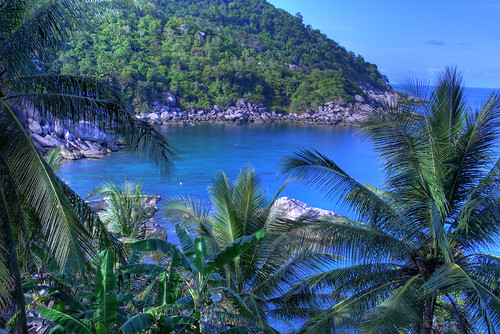
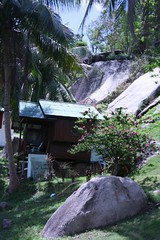 don’t count the one next to it which the owner says is haunted, and they never rent out.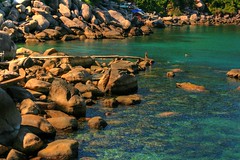
 Another good thing is that there is only power from 6:30 pm until early morning. This gives K a maximum of about 4 hours of battery time on the laptop, and then we have to do something else, like go snorkeling. Koh Tao is an international diving hot-spot, and in fact issues more PADI certifications than anywhere else in the world. We, as snorkelers, are the scooter riders of the underwater biker community, but the scenery off of our rocks doesn’t make us feel second class. We spend much of the day swimming around our 3-dimensional screen-saver of a reef. Next time I’ll come with a water-proof camera, and show you just how beautiful it is.
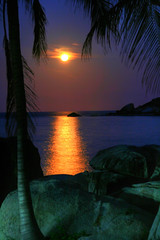 and windows open. The night after, however, there were such swarms around the bulbs that in the restaurant Soe, the owner, was scooping them away with a mixing bowl. There was a definite spike of activity that night, but it hasn’t been the same since. Now we have to close our door before we turn on the light, which still didn’t stop a beetle the size of a hamburger patty from trying to smash it down.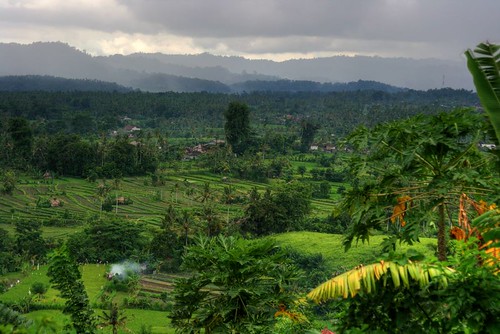
 throws, and taking the country down with it. People were rioting for food, atrocities were being committed against the Chinese and Christians (often the same thing; and often the scapegoats when things went bad), the Australian army was air-lifting their nationals out of the country, and the currency was close to being worthless. It was a traumatic time. A similar but bloodier scenario brought Suharto into power in 1965. I was only 4 at the time, but my family, who were living in Java, also had to flee the terrible circumstances. I went back in early 1982. At the time Kuta Beach was a quiet back-packer haunt, Legian was a separate village, and Ubud didn’t have any Italian restaurants. K had warned me it would
  be a shock to go back, so we have, over the years, left it off of our itinerary.
 that kind of power is.
 everything is made on Java. This is certainly true with the textiles, although we find many pieces from Sumba and Flores as well. We spend half a day in the cloth market in Denpasar, and are fortunate enough to meet Supriadi and his daughter Farhana. They are from Malang, in east Java, where I spent my childhood, and this connection is maybe why they give us the straight goods and the “harga bihasa’, the ‘real price’. We end up buying as many sarongs from them as we can carry on our bikes. Batik, of course, is an Indonesian word for the famous resist-dye process of applying wax to cloth. Although not a dead art, hand made batik is now mostly a high-end artisan-produced specialty. Most merchants will try to con you with either the very cheap “batik prints”- easily detectable because only one side has vibrant colour – or “machine batik”. These are actually true batik, except that the wax pattern application is done mechanically, and are impossible to distinguish from the hand made article- for me, anyway- except that each pattern is identical in every detail. In the end, the sourcing experience in Bali has made me appreciate even more the quality and the diversity of the hand-made culture in India.
 pared-down pack – which sits between my knees – on a short tour of the island. In fact everything is so beautiful we don’t end up going very far. The first stop is Ubud – a short jaunt inland – which has been a magnet for ex-pat artists since the ’30’s. Many foreigners have continued to settle here, and it is easy to see why. Ubud is built around a number of steep ravines and river valleys. Some of the most stylish
 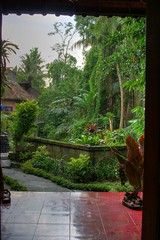 boutique hotels in Asia are built into the lush green slopes and we voyeuristically wander into some just to look around. The staff see through our grubby gear right away, but are always smiling and gracious. The great thing about Ubud is we can get a chi-chi room for economy rates. Peter shows us to a real gem: lovely gardens, a swimming pool, lotus pond, with our room individually set into the jungle above one of the rushing water courses – for $14! Again we curse ourselves for not budgeting more time here. It’s almost a blessing that for much of the next two days it rains torrentially in Ubud; we have to cosy up in our lovely room as the rain thunders and the thunder rolls.
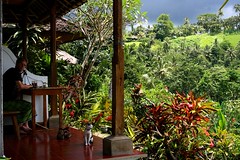 our guest house. Palm trees pose dramatically above a ridge of wild grass, patches of jungle foliage explode like green bombs frozen in time, and thick creepers try to blanket everything. The real eye-catcher though, is the elaborate rice terracing. The terraces transcribe every surface with an anarchic geometry, each patch a perfect shade of spring green. As if this wasn’t enough, people and nature have thrown extravagant colour into the mix. Frangipani and hibiscus and bougainvillea tumble from the garden in front of us; the butterflies are almost too much of a hyperbole to mention. A hummingbird with a long curved bill hovers for a second and nearly breaks my heart. Once you get over that there are the towers of clouds sailing
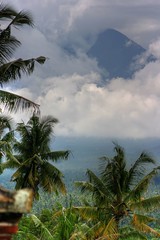
 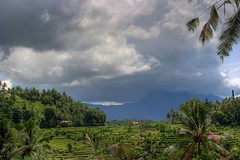 through the skies. They can be real drama queens, flouncing up their skirts, pouting black, giving mischievous glimpses of a huge volcano, and glamming it up for the carnival of sunset.
 long sarongs, and hopping through the thin, often muddy terraces, isn’t easy. As we get closer we see that, of course, there is an easier way, and on it are many men in traditional costumes and women carrying baskets of fruit and offerings on their heads. The Balinese love ceremonies, as one young man explained to us, not because they are necessarily deeply religious, but as much for the art and tradition. You could, in my opinion, make an arguement that there is very little difference.
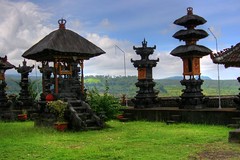 manicured landscape. The going is relatively easy, if a little indirect, and the worst thing is the over-protective dogs who always have to bark, and tell the next dog along the line that we are coming through. Eventually we reach the hill. For the first time that day, within sight of the temple, the paths vanish. The air is stagnant and the humidity is oppressive. For a couple hundred meters we are the suspicious focus of every dog in the valley, as we pull ourselves up the steep slope through thick elephant grass. The reward is a spectacular view – and of course, an obvious and easy way down. K. is enjoying dredging up some of her language skills unused for a decade, and jokes with locals that we pass.
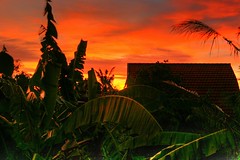 from here too soon.
 Back in Jaipur we are relieved that the cold wave which is killing people across North India hasn’t settled in here too harshly. The days are clear and sunny, around 20C, and at night it goes down to a bearable 8 or 9. Contrasting this to your reports from Canada – minus 50 with the wind in Winnipeg; too much snow
  to drive on the upper levels in Vancouver – I guess we shouldn’t complain.
 days and get the shipment on its way – but this doesn’t inspire confidence.
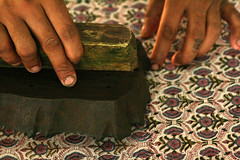
  produced. Now we are able to make a trip to the village of Bagru, where another style of printing, which our merchant calls “Bhooti” comes from.


 Growth has been so fast in Gurgoan that no one knows how many people are here, whether it’s 2 million or 10 million, only that the population has so far out-paced infrastructure and resources that even the model high-rises that are everywhere get only two hours of water per day, and 60% of electricity is pirated from the wires. In Noida farmers have made big money from selling to property developers, but the urban/rural divide is still stark. This last week a girl was sitting with her boyfriend parked at the side of the highway, when she was attacked and gang-raped by thirteen locals. The first reporters to the village encountered some extraordinary attitudes, including the head man saying: what’s the big deal; it was only a rape; and the grandmother of one of the accused: they shouldn’t have had a chance to rape her; she was acting indecently and should have been stoned, first.
 The trip to Varanasi is uneventful, and there we have two tasks. The first is checking up on another of our orders, which is (deja vu) supposed to be ready to go. We always like to visit Ajit, but this time he has neglected to finish some of the seams inside his duvet covers. This will take another ten days.
 here. We find a nice cast-bronze figure in the market, and Katheryn decides it will add significance if it is blessed at one of the shrines . There are three that I know of on the way down to the Manikarnika Ghat, the famous open-air cremation site on the banks of the Ganges. The first one is managed by a guy we have known for years. He is also a fairly heavy user of a certain sacramental herb favoured by Shiva, and is apparently unavailable somewhere in the back.
 and have a row on the Ganges.
 with the guy on the end of the line telling him the train which left ½ hr. ago isn’t there yet. But this doesn’t help us, not even with getting a refund. The rules state that if you miss your train, you can get a 50% refund within the first three hours. It seems self-evident to everyone we talk to that a) the train has been missed and b) the refund will be 50%.
  exhausted brain has a good idea: we can change our Bangkok flights! With some of the pressure off, I go in for my interview with the Big Boss. He is sympathetic, but about a full refund he spreads his hands. “Even I” he says, “can do nothing.” He also assures me he will pull some strings, and get us berths on an otherwise-full train this afternoon.

 Palitana makes a convenient stop-over on the way back to Ahmedabad, but it also a well known Jain pilgrimage site.
 basically a simple palaquin carried by two porters up the hill. The dhoolie guys are especially persistent, and keep soliciting as we climb. The staircase is broad and even and packed with people even though it isn’t a special festival or holiday. There are many families, obviously city raised, with digital video cameras and designer sunglasses, but there are also barefoot pilgrims clad in white cotton. There are no other foreigners. For the most part we keep our heads down and trudge, like everybody else. The descending dhoolies shout at you to make way, and a surprising number of young men and women are running down the stairs.
  might not be the original stair – this hill had temples two thousand years ago – but when we leave the commotion of the main trail to follow it we enter a different time.
 idol is meaningless for me, and K. and I climb up the temple as far as we can get to get a view.
 crowds are far thinner. From here, after scampering up to the top of more temples, we get even better views. Going down we fall into step with a young man, Mukesh, accompanying his friend. Mukesh is fascinated that two people from a distant country would be on the Palitana hill. He is genuinely happy for us, that we would get the blessings for making the pilgrimage to the top. His friend, however, is on a much more serious quest. According to their beliefs, if the hill is climbed seven times in two days, without taking food or drinking water,
 7:30pm and our round trip took three hours. That is why people are running down. That is why there are numerous white robed devotees, barely able to walk, supported on the shoulders of friends and family. For Mukesh’s friend, this is the last descent, and although he is obviously exhausted, he is doing well. It wouldn’t be hard to die of heat stroke undertaking such a grueling challenge and we have seen a number of people lying on the ground in obvious distress. After just one climb, our legs are screaming for days. It seems impossible to me that someone could do this seven times – that is 49,000 steps! But then the important thing, for more than physical conditioning, is to have faith.
 hunting retreat converted into a hotel. We tried, but there was no room at the palace, so we had to settle for the seriously down-market option of a $10 place in town. Being New Year’s Eve,
 crumbing battlements. Chittor is impressive for its size – it is built on a flat top hill and the area enclosed by its walls is 28 sq. km. Inside there are the obligatory atmospheric and photogenic ruined temples and palaces. What it is most famous for, however, is the unaccountable fact that it was taken in battle so frequently, and the resulting “jauhar”. In the Rajasthan of the middle ages, losing a battle didn’t merely mean raising a white flag and surrendering. When all hope seemed lost,
 nearly everyone lived inside the city walls, and he talks about growing up here with understandable nostalgia. In general I hate being saddled with any sort of guide, but Kailash does a good job of staying out of the way as we clamber about ruined and rebuilt temples, palaces and battlements. The most famous monument
  in Chittor is the Jayastambha a
 the great road up, once contested by the troops of the Mogul Emperor and suicidal Rajput warriors is now a rough track used by village women.
 quirky, like the Andamans, but not as distant.
 Diu one day at a time, by bus.
 recommended by our friend Peter who was just there – and it is quite lovely.
 station, Roger Moore’s rocket-propelled auto-rickshaw ride through town doesn’t seem too far from the truth.
 main drag is the totally-inappropriately named Relief Rd, and our hotel is just off it. The last time we were here our room actually rattled due to the traffic. Now we have gone a little more upscale, and it is worth it. Since we are in the textile business, and since our hotel is alright, we decide to see if there is anything in this town we might be interested in. Ahm’bad, after all, is the capital of the state where much of our tribal embroidery comes from. We visit a night market and find a lot of cheap-quality knock-offs, but also some old and/or good pieces. The prices start out astronomically high, but competition is so keen that they quickly come down to absurdly cheap. I’m not interested in doing business this way, and no one, of course, has any of the commercial
  licenses necessary for exporting, so K buys a couple of blouses and we leave.
 highway in rooms that were once (on one wing) for the palace guard, and (on the other) their horses. As we wander through the streets we stumble on a square of grand four-story buildings – the tallest in town – that look like they belong in Whitehall, but which are now encroached upon by tailors and mechanics – and even for them the upper stories are too run down to use. People aren’t used to foreign faces here, and everywhere we are greeted by smiles and kids calling out their text-book English phrases. K makes the observation that a group of sari-clad young women who giggle and say “Hi!” are black, with frizzy hair. Soon we are seeing local “blacks” everywhere. When we are back in our room I do a Google search (in case that went by so quickly that you missed it – for the first time in all our travels we have wifi in our room. In Junagadh! Our swish hotel is actually a christmas present from Marianne – Thanks again! ) and discover that many blacks came to this part of India from Ethiopia and East Africa to work in some capacity for the Maharajahs. They are called Sidis, and now dress and talk like the locals, although even after 200 years inter-community marriage is uncommon.
 collectively know as Roma, or Gypsies.
 be looking at you.
 the foreign tourist scene has had a minimal impact on this out-of-the-way spot. Part of the reason is that the beaches leave something to be desired, although we haven’t done the full tour yet. This is the holiday in India part of the trip, and we are treating it that way. We start the day with a coffee on our balcony, looking out over neem and palm trees to St. Paul’s church. Then we find food, wander around the picturesque old city, and finish with cold beers on a roof top with
  our friend Peter. It may not be sleigh-rides and sitting on Santa’s knee, but I am quite happy to spend Christmas this way. And on that note: Seasons Greetings to you all, may your Christmas be joyful and may good things come in the New Year!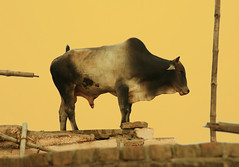
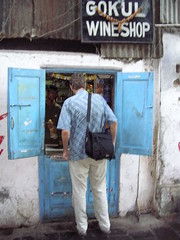 neighbourhood we are so fond of (including the Gokul, where we bought beer, and where a bomb was found).
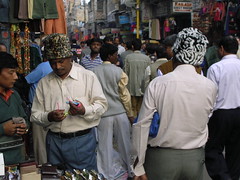 Delhi train station, had been the victim of a bomb blast last year.
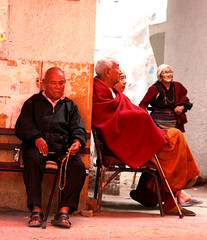 burgundy-robed community was watching closely.
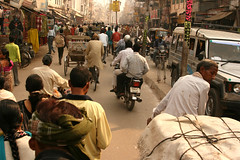 our visits here, we decided to stay outside of the noisy carnival of the old city.
 a duvet set we designed to be even more robust than last year, and some of the specialties of the area like the zardozi work.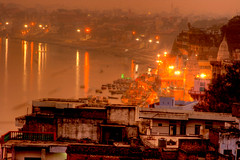
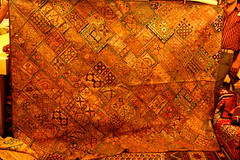 range.
 entrepreneur.
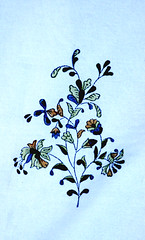 and while it would be romantic to say it was a village of mud huts in the desert, the reality is that the village has come to the city.
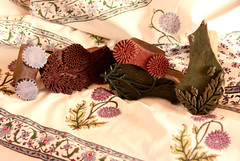 requires the use of five different blocks, applied by hand, for every flower on the sheet.