
CENTRAL INDIA: Caves, ruins, and a very big tree

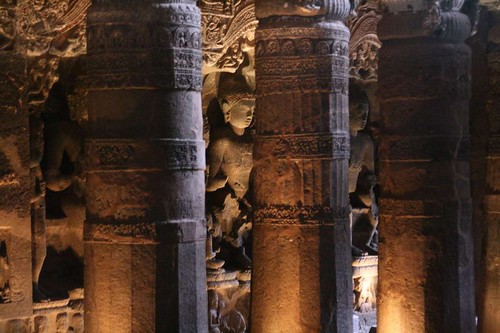
From Aurangabad and the cave temples of Ellora we start to arc north on our big loop through central India. The next destination is another great cave temple site, Ajanta, older and if possible even more impressive than Ellora. After that we continue on to an extremely old Buddhist pilgrimage site, Sanchi, via the infamous industrial city of Bhopal, and then, somehow or other, back to Delhi. This is the “hard travel” part of our trip. We have to find local buses, trains, or other transport as we go. There are no schedules, and no reservations.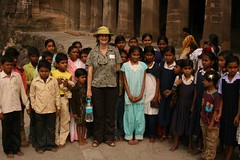
The first leg, from Aurangabad to Ajanta, is an easy one. Although there is no English – numerically or alphabetically – at the bus stand, lots of people direct us to our bus, which is just pulling out, and magically still has seats. It drops us directly in front of the only reasonable accommodation in the village of Fardarpur, and just like that we have arrived and are settled in.
We are definitely objects of curiosity when we take a stroll through tiny Fardarpur, but the attention is unanimously friendly, and even heart-warming, as when a bullock cart of villagers lumbers past and everybody in the back – mostly women and girls – waves and flashes brilliant smiles, and keeps waving as they trundle up the road. It has been eight years since we were last here, 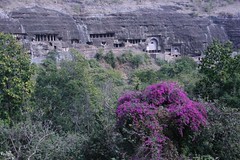 and I remember buying a cold beer at a small shop just north of the town, but now I can’t find the place. We ask a small knot of young men, and they say it is 2 km further. There is an auto-rickshaw beside them, and I say I’ll take that, but everybody, including the driver, agrees that he will charge too much. One guy flags down a 100cc motorbike, tells him what we want, and Katheryn and I squeeze on board. Our driver’s name is Ali. He is about to move to Ireland to be with a girl he met, and has no idea what to expect. We complete our errand, and Ali refuses any payment, even a contribution to his gas money.
Ajanta is a jewel. The 30 caves were carved by Buddhist monks, the interiors covered with stupendous frescoes, and the whole thing was abandoned by the end of the 5th C. The stunning paintings weren’t seen again until 1819, when a British army officer stumbled on the site, 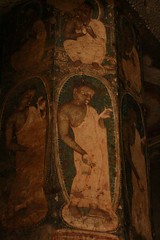 following the Waghora River hunting tigers. There is still only the same approach, up the Waghora valley, into the box canyon where the caves form a horseshoe in the cliff face. Those of you who know Ajanta know what an amazing place it is. I won’t go into the details here, but let the pictures speak for themselves. More can be seen below, or on our flickr site, of course.
The next leg of our journey, from Fardarpur to Jalgaon, although short, could be a problem because we have to flag down and board a bus in mid-route, and you can see, if you watch some of our bus videos like this one: bus through Madhya Pradesh how full the buses can be. As it turns out, the bus nearly empties out when it stops, and we actually have a selection of seats to choose from. Jalgaon itself is just a transit town on the rail line, but it has a nice hotel, the Plaza, whose charming owner greets us warmly. There is a waiting list of 29 for the train we want to catch to Bhopal the next morning. It is an early train – 6:30 a.m. – and by the time we get to the pre-dawn platform, our seats are confirmed. This is all just too easy! Where is all the hard travel I was dreading?
Bhopal will always be associated with the worst industrial accident of all time, when a gas leak from the Union Carbide plant seeped out into the city, killing 20,000, and destroying the health of 120,000 more. Admittedly, that isn’t likely to be a big draw for visiting the city, and since we didn’t find anything else that is, I would say give the place a miss. We arrive on the eve of the loudest Hindu festival of the year, Shivaratri, and are in a room directly across from a temple. The blaring broadcast, the manager says with conviction, will stop at 11 p.m. What he didn’t tell us was that the marble tile cutting in the next room wasn’t going to stop until the 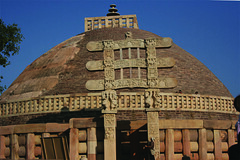 room was finished. The din in the room is unbelievable, and, tolerant as we are, we have to move when the shriek of saw cutting stone drowning out the blasting loudspeaker becomes too much.
Sanchi is only a speck on the map 69 km from Bhopal, but still we weren’t expecting the bus to take 3 hr. to get there. It just crawls along through the Madhya Pradesh countryside, stopping every few hundred m to let off or pick up (mostly) passengers. People seldom get on singly, but in extended family units. The strongest – the young men – make it on first, and with the aisles already full, it often leaves old women or children to be crammed together in the doorway. The situation looks grim until the next stop, when another 8 or 12 or 20 people somehow manage to squeeze in, and then it gets worse.
Sanchi is the oldest site on our route – it has been a pilgrimage destination since the 3rd C B.C.,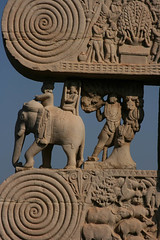 when the Emperor Asoka built a domed stupa over a relic of the Buddha. The stupa still stands, and Buddhist pilgrims still come – a group from Cambodia are here with us – but what Sanchi is famous for are its four gates. Called “Torana” they consist of two stone pillars supporting three horizontal beams, and they are the best, earliest, carving in India. The sculpture really is spectacular, but we had hoped Sanchi would be the kind of peaceful hamlet it would be nice to spend a few quiet days (after Bhopal) in. Unfortunately it’s just a rather unattractive strip on a busy road, and we decide to move on, the next day, to a beautiful spot we know, Orchha.
This involves picking up the (packed) bus from yesterday, which continues onto the town of Vidisha. From where we have to hope for seats on the six hour train to Jhansi. The good news is we get into one of the upper class compartments; the bad news is that we were sold the wrong kind of ticket at the station, and have to pay a “fine” of 500 rupees. In Jhansi station, before we head out to the village of Orchha, we try to buy tickets for our last leg, to Delhi. It’s such a chaotic scene 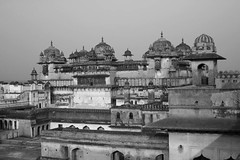 that I am in line for an hour and a half before I get to the window and then I can only get us on a waiting list.
It’s a hassle getting out to Orchha, with taxi drivers telling us “there are no buses”, but it is worth the effort. The village of Orchha is sandwiched between a massive palace and a huge temple from the 17th C., and the countryside is dotted with ruins. We spend a day cycling around and are attracted to a giant 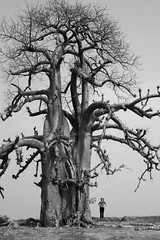 baobab tree standing alone on a hill. It is a tree that seems to be older than its country, to have created the magical landscape around it.
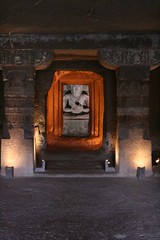
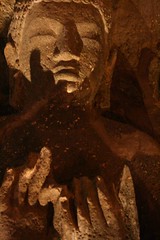
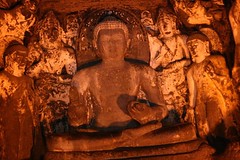
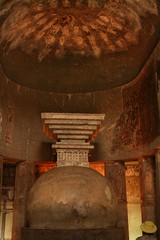
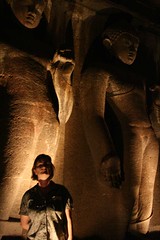
See lots more fabulous photos at https://www.kebeandfast.com and don’t miss the videos:orccha palace , sanchi ,and ajanta.

 two years. The humid coastal air, the grand colonial architecture, the vibrant culture, and the dynamic intensity of an entire country-worth of people compacted into a pressure
 came out with the seemingly-innocuous statement that Pakistanis should be allowed to play on Indian-based cricket teams. For this the Sena is screaming patriotic invectives at him, and tearing posters off theatres, and threatening to riot in any movie house which shows his latest film, which is to be released this weekend. The biggest story, however, happened today. Rahul Gandhi, scion of the Nehru clan, son of the martyred Rajiv, heir apparent to the venerable Congress Party and P.M.
 talking with two young women beside her. They are Muslim, and although they are following events in the city closely, they are scared to be overheard talking in public about them. We are heading Aurangabad, named after the (Muslim) Moghul emperor, Aurangzeb. The Sena are great revisionists, and want to change the name to something more “Hindu”, as they did with Bombay/Mumbai. But there are too many Muslims here like Katheryn’s friends, and so far it has not been possible.
 Ellora were probably coming from Eastern India, and as they developed they became known as ‘Tantra”. Tantra envisioned complex cosmologies around the Buddha, powerful associated figures like Bodhisattvas, and esoteric rituals designed to fast-track what had been a slow evolutionary approach to the final goal: Nirvana. Here in Ellora the monks were working to create what was in effect an Enlightenment Machine. In each new cave, at each new try, they were refining it further. They used the most powerful tools at their disposal: pure compassion symbolized by the Bodhisattvas Avalokiteshvara; enormous figures of the Buddha, his hands forming
  esoteric gestures to instruct the initiated; and, most importantly, the monks put all the elements together to form three-dimensional mandalas which are the cave temples.
 destruction.
 then the carving was started from the top down. It’s one of the truly audacious ancient works of art on the entire planet. All the temple courtyards, sculptures, shrines and sanctums were hollowed out and now you, and busloads of tourists and school kids, can wander through it, taking dark stairways to different levels, and wondering how it is possible to take a defining photo in such a tight space.


 Back in Jaipur we are relieved that the cold wave which is killing people across North India hasn’t settled in here too harshly. The days are clear and sunny, around 20C, and at night it goes down to a bearable 8 or 9. Contrasting this to your reports from Canada – minus 50 with the wind in Winnipeg; too much snow
  to drive on the upper levels in Vancouver – I guess we shouldn’t complain.
 days and get the shipment on its way – but this doesn’t inspire confidence.
  produced. Now we are able to make a trip to the village of Bagru, where another style of printing, which our merchant calls “Bhooti” comes from.


 Growth has been so fast in Gurgoan that no one knows how many people are here, whether it’s 2 million or 10 million, only that the population has so far out-paced infrastructure and resources that even the model high-rises that are everywhere get only two hours of water per day, and 60% of electricity is pirated from the wires. In Noida farmers have made big money from selling to property developers, but the urban/rural divide is still stark. This last week a girl was sitting with her boyfriend parked at the side of the highway, when she was attacked and gang-raped by thirteen locals. The first reporters to the village encountered some extraordinary attitudes, including the head man saying: what’s the big deal; it was only a rape; and the grandmother of one of the accused: they shouldn’t have had a chance to rape her; she was acting indecently and should have been stoned, first.
 The trip to Varanasi is uneventful, and there we have two tasks. The first is checking up on another of our orders, which is (deja vu) supposed to be ready to go. We always like to visit Ajit, but this time he has neglected to finish some of the seams inside his duvet covers. This will take another ten days.
 here. We find a nice cast-bronze figure in the market, and Katheryn decides it will add significance if it is blessed at one of the shrines . There are three that I know of on the way down to the Manikarnika Ghat, the famous open-air cremation site on the banks of the Ganges. The first one is managed by a guy we have known for years. He is also a fairly heavy user of a certain sacramental herb favoured by Shiva, and is apparently unavailable somewhere in the back.
 and have a row on the Ganges.
 with the guy on the end of the line telling him the train which left ½ hr. ago isn’t there yet. But this doesn’t help us, not even with getting a refund. The rules state that if you miss your train, you can get a 50% refund within the first three hours. It seems self-evident to everyone we talk to that a) the train has been missed and b) the refund will be 50%.
  exhausted brain has a good idea: we can change our Bangkok flights! With some of the pressure off, I go in for my interview with the Big Boss. He is sympathetic, but about a full refund he spreads his hands. “Even I” he says, “can do nothing.” He also assures me he will pull some strings, and get us berths on an otherwise-full train this afternoon.
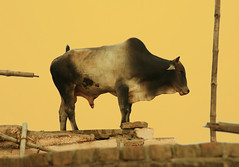
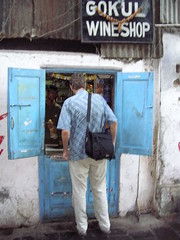 neighbourhood we are so fond of (including the Gokul, where we bought beer, and where a bomb was found).
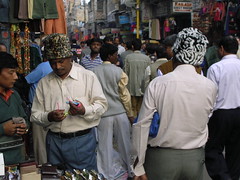 Delhi train station, had been the victim of a bomb blast last year.
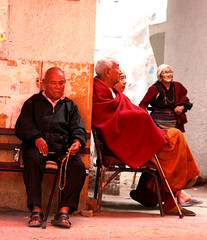 burgundy-robed community was watching closely.
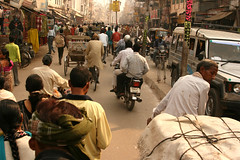 our visits here, we decided to stay outside of the noisy carnival of the old city.
 a duvet set we designed to be even more robust than last year, and some of the specialties of the area like the zardozi work.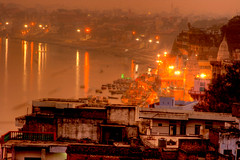
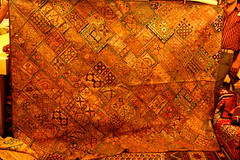 range.
 entrepreneur.
 and while it would be romantic to say it was a village of mud huts in the desert, the reality is that the village has come to the city.
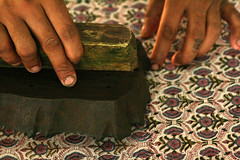
 requires the use of five different blocks, applied by hand, for every flower on the sheet.