
NEPAL: FOR THE LOVE OF PAVEMENT


The unstoppable force of India collides with the immovable mass of China and Nepal is the balloon squeezed between the two. The pushing continues: the Himalaya are still fracturing upward and the government is still simply fractured by the impact of it’s giant neighbours. The China-supported Maoists won an election in 2008, but intractable issues with the India-backed Congress Party made governing impossible, and the only hope was that a new constitution would lay the groundwork for a return to normalcy. Now the negotiations over the constitution are in a deadlock, there is no functioning legislature, and no end is in sight. But actually, most people barely notice.
Sure, civic functions like garbage collection are sporadic; the plastic bags of refuse discarded on the street when we arrived are still there days later, mashed into the potholes by traffic and picked over by dogs, cows and crows. Our friend Malik  explains that the garbage collectors are from the villages and in the Maoist camp, and if they don’t want to work no one will make them, and they have all taken two weeks off for the holiday of Dusain.
Our timing, in that regard, is very fortunate. We arrive at the tail-end of Dusain, and our jewelery-makers are drifting back in from the villages, so our orders can get started. Everybody knows about the increase in the price of gold this last year; the same is true of other metal. Copper, tin and zinc are all more expensive, and silver had increased 50%. This means we are buying a lot less silver jewelery, and a lot more copper, brass, and “white metal” (steel, aluminum, and – Malik shrugs his shoulders – whatever they have). We still manage, of course, to get some extraordinary pieces, including lots more styles of rings, and some very dramatic Afghani-style cuffs. And singing bowls. Our most popular bowls last year were  the antique “thado-bhuti”, which come from the Tibetan border regions and are, according to the famous Tuladhar brothers, Ishwor and Suman, up to 100 years old. We spend a morning in an ancient room in the old city of Kathmandu with Ishwor, each one of us in turn handling the bowls and making them sing and selecting from his stock 30 of the thado-bhuti, based on their tone and quality. They will be a little more expensive than last year, but if you pre-order from us now we will reserve them at the old price. Drop us an email if you are interested.
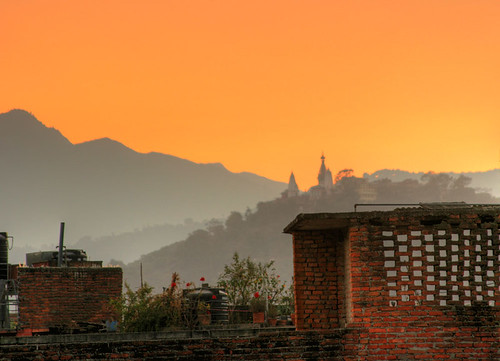
When all our orders are done, Malik suggests we make an outing to Nagarkot, which is a village on a ridge outside of Kathmandu with a glorious vista of the terraced foot-hills set against the snow-capped Langtang Himal. We leave the city  on the road that leads to China. Now it is a horribly dusty construction zone of constant pot-holed diversions – but soon it will be Nepal’s only four-lane divided highway. Geo-politically, you could probably read something into building a free-way to China, and leaving the road to India – the one we will take tommorow – to rot.
Kathmandu holds a special place in our affections, but it is still a noisy, polluted Asian city, and we are craving something a little less frantic. Rather than head into the mountains – the destination of almost all of this year’s bumper-crop of tourists – we journey down to the plains to an area of forest and rice-fields bordering India known as the Terai. The famous destination here is Chitwan National Park, home to a dwindling population of tiger, elephant and one-horned rhino. I have a disabling aversion to group tourist activities, so I am confined to the hotel while Katheryn has a wonderful time riding  into the park on the back of an elephant named Circli, even though her party doesn’t see any major wildlife. What we can both do, however, is rent bicycles and explore the beautiful surrounding villages where the rice harvest is in full swing.
If the main road from Kathmandu to India – which takes us by Chitwan Park – is bad, the road east across Nepal is legendary. Granted, much has been paved since the bad old days, and the journey has been reduced from unbearable to merely uncomfortable. We decide to take two days to do the 440 km, breaking half- way at Janakpur. We leave Sauraha early the first morning, advised that the best way to get from the village to the main highway is by horse cart. That seems reasonable, except that no horse carts appear, and we are forced to make bad puns about falling into a trap. Eventually a curious pick-up driver stops and we negotiate a ride with him. Getting transport mid-route is always a bit of a risk, since buses generally arrive full, and carrying our luggage as we are it is difficult to get on and hope to secure a seat. Janakpur is  also an unusual destination, and after flagging a couple of buses to a halt and getting no satisfaction we decide to go 20 km the OTHER way, to the major town of Narayangarh, and hope to get something from a terminus. Instead we are dumped at a noisy junction in the middle of town. It always happens, though, that when you simply throw yourself into the sub-continent, you are taken care of. Someone asks us where we are going and leads us to a Nepali-labeled hole of an office, and someone else sells us a ticket to Janakpur, leaving at 10. There is enough time to go for a bite at a simple place next door, and Katheryn gets entertained by a young girl intent on dancing for her while simultaneously reciting the English alphabet. Then someone grabs our bags and runs off announcing our bus has arrived. The bus is packed, but two seats are cleared for us, and with our bags in the aisle getting climbed over by the standing passengers we head off. Only the last part of the trip, 7 hours later, is really bad. That’s when the pavement has disappeared and we are bucked off our seats as the driver takes on the potholes as if they are trolls in a video game. Then again, Katheryn reminds me of the part where the rest-stop is just the side of the road, and she has to squat partially-concealed by some bushes as a group of curious cyclist ride past. Or the part where she has to hand our bags out the window to finally get stowed properly and wrenches her back in the process.
And so it is, with Katheryn barely able to walk in the morning, that we prepare for the next leg, to Karkabitta, on Nepal’s eastern border. The bus  originates in Janakpur at least, but at first glance it doesn’t inspire confidence. It’s been twenty years since anyone cared what the interior looked like, and the cushion on our wooden plank bench is so ragged I pick up the whole thing and change it with another that is marginally better. We are right behind the driver, which allows Katheryn to brace herself on the wheel well, but the speakers from the stereo are six inches from my head, and we spend most of the trip wearing earplugs. It’s not everybody’s idea of fun, but it’s what we do, and I love the fact that we are in a relatively remote and beautiful part of the world surrounded by people who accept our presence here with so much hospitality, and there is a price to be paid for that privilege. Katheryn, as always, maintains her sense of humour, and coins two apt phrases: ” He’s got balls of nerves” as the bus holds the ribbon of asphalt for as long as possible against oncoming traffic; and the immortal ” For the Love of Pavement!”
Be sure not to miss these videos of the experience: http://www.youtube.com/watch?v=YF3pdGGMUsk; http://www.youtube.com/watch?v=JY_9P1-0xcw; http://www.youtube.com/watch?v=AfY_eIA94I0; http://www.youtube.com/watch?v=6IxYz1Lwbpc; http://www.youtube.com/watch?v=JP6ZGem87Oo. Or just go to youtube and search for kebeandfast to see all the choices.
And there are lots more photos: http://www.flickr.com/photos/croquet
 The flight path from Bangkok to Kathmandu hasn’t changed;
 itinerant shamans, whatever the case may be. For the bicyclists who speed downhill -without a light of course – the effect must be absolutely hallucinatory.

 eye. On the downside, two people we felt a strong connection with are gone. Namgyal Lama, our shipper, who has always had a twinkle in his eye, and was known to the community as ‘Foxy’ for his wit and smarts has died of cancer; and Kasang who ran an antique store within the compound of the Bouddhinath Stupa was unable to survive the last year and is out of business. Malik told us the Chinese had recently stopped granting visas for non-resident Tibetans wishing to travel there, and this likely finished Kesang’s business off.
 character. A Tibetan yak drover for instance, would feel quite comfortable in the room in the old mansion that we find. It’s true, at 6’4″, I’m of somewhat different stature from the locals, and for much of the two flights of stairs up and down, the back and forth to the outside toilet, and walking about the primitive
 A short walk away is the old market and assembly area, the Dhulikhel, now a dusty flat ground surrounded by ancient banyan trees with an impossibly majestic view of the Ganesh Himal and the Annapurna range. It’s Saturday, the day off at the local girl’s school, which also attracts busloads of boys from the valley. They all gather at the Dhulikhel to mingle, play music, and have picnics and party. We fall in with a group of ravishing girls led by Shushima who give us flowers, practice their English, and call after us “Kat- a-rin, you are
  beautiful!”.
 and at one point, reflecting how many of us feel, pees on the floor.
 bougainvillea. Yes, there are scads of tourists, but there is also such a plethora of accommodation and services that we can find a lovely picture-window room with said vista for less than ten dollars. It is easy to wile away the days doing nothing but sampling the restaurants between morning
  it. This is also our last high point. It is downhill all the way to India. The descent begins with a long, long, staircase to lakeside.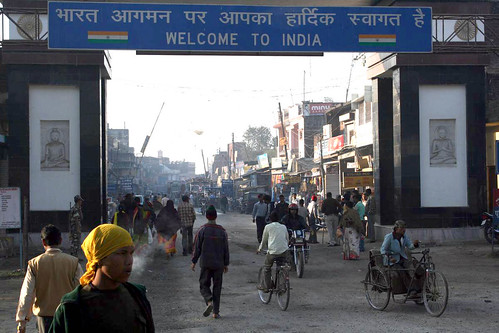
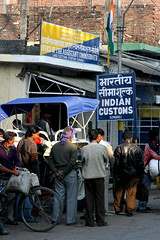
 We turn off the highway and find ourselves on an elevated, single lane brick track, more like a drainage dyke than a road, running through the countryside. With rice paddies on each side we bump along in a cloud of dust about 10 feet above the fields. Ironically, the bricks in the road we are following are yellow.


 I am 27,000 ft above the plains of northern India. They couldn’t be flatter. Big rivers meander across them like fat pythons, leaving tracks of sandbars and abandonned ox-bow curves. I can see villages stretched along the banks, and everywhere the geometry of fields. The only places where there aren’t any signs of human impact are the flood plains themselves, reluctantly left alone because of the power of the monsoon. Earlier this year the floods hit hard; the rivers broke their banks and milions of people were displaced.
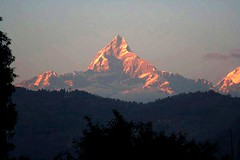 Langtang; Everest. Or is that one Everest? Well, it could be- it’s big, white, and in the Himalayas…
 Kathmandu’s airport is rapidly becoming engulfed by the sprawl of the city, and it looks like we are going to touch down amid the flat-roofed three story concrete buildings as we approach the runway.
 Kishan supervises the operation. In the winter there might be ten men working here. Now there are only two – the rest are back home for the harvest and the festival. They are paid by the piece, and make $200 to $300 /month, about the same as a teacher in the village, and are provided with room and board.
 the area of Kathmandu where we live, is a chaotic few blocks of shops, guest houses and restaurants. One of our favorites is a little Tibetan place tucked back behind a row of shops called Gurung. It has the best tongba in town. Almost always there are locals sitting around in the dim light, on their tables flagons with metal straws sticking out of them, and a thermos of boiling water. In the flagons are a couple of cups of fermented millet, like coarse dark sand. Hot water from the thermos is poured on top, and after a few minutes it turns milky. The metal straw is pinched and perforated at one end, so that none of the grain mixture is imbibed when you take a sip. Tongba has a slightly sour, saki-ish taste, but is very mild. Hot water is continually added into the flagon, and after a litre or more, when the flavour starts to diminish, it feels much the same as having drank a beer. But on those cold Kathmandu evenings there is nothing like it.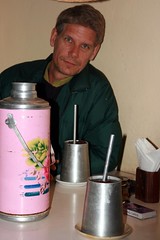
 view. The fish tail mountain is sacred, and never been summited. Mountaineers can only go within 100 meters of the top. Annapurna II and IV, David guesses, are the two other big boys in our back yard, and measure in at around the 8000 meter mark. We arrived by rather luxurious bus yesterday. Having upped our budget by 50% we can splash out on the $15 ticket. Lots of leg room, decent lunch provided, no music, didn’t take on passengers or let others alight mid-trip – and no chickens, sacks of onions or bundles of steel pipe underfoot.
 Drying corncobs give a picturesque detail along the glassless window frames. Beautiful as it looks, this is tough living. People eke a livelihood from two-foot-wide rice terrraces carved 1000 feet up the slope, and water has to be carried long distances from gravity fed water taps sticking out of the trees. It would be a real struggle to provide one’s basic needs.
 launch from, and it provides stunning views all around. We stop at a small shop for breakfast, and have tea with an incredible vista of Machchapuchare and the Annapurnas. I don’t see the need to go the remaining few hundred metres to the top of the hill, but David is keen, so I sit in the sun and talk with the owner. She has problems. During the monsoon in August, a landslide took out the slope in front of us. Then another one directly behind took away her buffalo paddock. There isn’t much land left on the razor’s edge we sit on, which represents her life savings. To stabilize the slope with concrete she estimates will take a year’s income, and even then nothing is gauranteed. She says that there has never been a monsoon as severe as this last one, and is willing to take her chances. It seems to me, though, that she is another casualty of the bigger climate disaster we see everywhere, and more severe conditions are what we can expect.
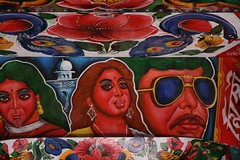 We left the shady streets by Rambutri Wat,Banglaphu, on the mini bus for the airport at 2 pm. We have a flight to Kathmandu thru Dhaka on GMG airlines, which will require an over night stay in Bangladesh. After last year we decided we preferred this over flying to Calcutta and going overland thru Bihar to Birganj. We all remember what happened in Birganj last time? (check ‘Escape from Birganj’ in the