
This week in Delhi

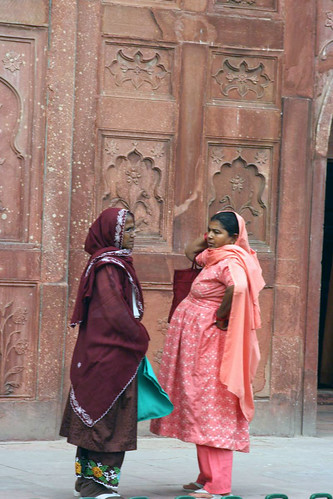
This week in the Delhi: the political arm of the Hindu fundamentalists, the BJP, has just won its third consecutive majority in Gujarat state, and the cadres are feeling frisky. They stage a large rally in the capital, and make sure it will be well attended by busing in loads of villagers from the countryside. We are on one of our usual rabbit-runs through the city, taking the metro from a suburb where our duvets are being made to New Delhi station to change money at the jewellery shop in Pahar Ganj which gives the best rates in the city. When we return to the metro station, even in this land of immense crowds, we are taken aback. There appears to be a line to go through the security check (where I, like everyone else, am always frisked, and my bag always checked), that extends four deep all the way up the stairs. There must be 500 people in line. We do the Indian thing, and see if we can get to the front of the queue. Fortunately, this huge group seem to be all together, and not at the moment trying to get to the metro. Later we learn that they were some of the 100,000 people who tied up the city with their rallies and marches. And the issue that is so important to them? They want the supreme court to rule that the shallow submerged shoals between India and Sri Lanka are the remains of a bridge constructed by the monkey army of the god Rama, and not a natural formation. People have already died over this issue, and the BJP and their right-wing cronies see it as a way to either galvanize the Hindu vote for themselves, or force the secular parties into an increasingly hindu-ized position.
We have been spending a lot of time in Delhi, and not from any particular attraction to the place. Apart from the Tibetan Colony, where we stay, it doesn’t really generate a great deal of affection. At this time of year the winter winds are blowing, and we are in a cold-spell which is seeing night-time lows plunging to 3 degrees. For Delhiites, this is  bliss, since most of the year they endure +40 and dust, but we whine and pull on our down jackets. What Delhi has become for us is a production center. We make 3/4 of our bedding here now, dealing with Deepak, who has a small but modern factory with good light and new sewing machines, swatch books and numbered dye-lots. In the same neighbourhood is the husband and wife team of Parminder and Amrita. They know everything about scarves, and expose a lot of the myths that we have been fed from other less-reliable sources. Silk cotton viscose rayon and all the varieties of wool… there are some
  very good imitations and unscrupulous dealers out there. Within the environs of Delhi and the neighbouring Punjab is where much of the post-handloom production for these goods takes place, and Parminder personally oversees the patterns and fiber content of his scarves. One of the most beautiful things we find is a woolen shawl with Kashmiri embroidery. These are still made by hand in Kashmir, and they are amazing, and they cost a fortune. The ones we buy are Punjabi-made, and although the embroidery is done with a machine, it still is the result of the skill of the worker using the machine, and is hardly less impressive. An embroiderer makes 320 rupees/day, compared to the minimum wage of 150 rp, and it takes 2 1/2 days to do the most ornate shawls. A hand-embroidered shawl of the same complexity takes a month. We also find some fun things, like the classic Delhi carry-all, the recycled
 advertising bag. These were originally made to promote everything from toothpaste to Bollywood blockbusters, and are the everyman’s bag in this city.
“Go to the source” is our motto, and it has led us on many wild chases throughout the less-travelled parts of this country. Last year we crammed into one rattle-trap bus after another, traversing all the small pitstops (and flea-pits) of western Rajasthan searching for the source of the tribal embroidery  work for our wall hangings. Then we found Kishor, in Jaipur. Kishor’s family is from Sindh, in southern Pakistan, and was displaced during the disaster of partition in 1947. His grandfather was in the textile business, and they moved to Barmer, across the border in Rajasthan. We also went to Barmer, hearing that it was where much of the embroidery comes from. It turns out that this is like going to Saskatchewan to buy bread because that is where wheat comes from. The embroidery certainly passes through Barmer, some of it local, some from Gujarat, and much, now, from Pakistan. But it
  filters through all the villages, and very little can be found in any one place. Dealers like Kishor and his father buy it from many sources, and then are able to amass a reasonably good selection. Once again, the rapidly changing times in India are evident: much of the best Indian tribal work is getting harder to come by, and is being replaced by characterless modern embroidery. The best stuff now comes from Pakistan, from Sindh and Baluchistan, and we find some wonderful pieces at Kishor’s.
The challenge to doing business in India is still largely a hangover from the days of the “permit raj”. The bureaucracy was inherited from the British, but the status of possessing a government job that had to be jealously guarded was an Indian development. It was therefore far more important for the clerk to make sure that there would always be a need for him than to actually get anything done, and he became the “Raj” of his own little “Permit-aucracy”. The bugbear for us is the IEC number. Every merchant we buy from has to have one, otherwise our goods can’t be sent as a commercial shipment. Even when they have the IEC#, each supplier is treated as a 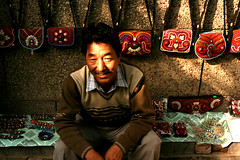 separate shipment, and the costs multiply accordingly. If we come across a local artisan producing treasure, we have to carry it out with us in our luggage. Sometimes we just can’t pass it up, as with Topkay, the Tibetan gentleman who sits at the corner of our alley everyday beading bags. Fortunately, Parminder agreed to do us a favour and include Topkay’s bags in his shipment (for a price, but that was reasonable), and we put
  in a sizable order with him. Topkay has been at his corner everyday we have been here, but the day after we payed him he wasn’t. I hope that with the little windfall we gave him, Topkay took a holiday.

 live at Scindia ghat, which is to the east of center. In front of our window is the leaning tower of a temple too heavy for its foundation, now picturesquely subsiding into the river. From our hotel we walk down a dark flight of steps, and as soon as we set foot on the ghats above the temple someone yells “Hello! Boat?!” It is a greeting we will hear several dozen times a day, touts trying to take us for a ride on the river. A few steps along and we are at the wood piles of Manikarnika Ghat. This is the most auspicious – and expensive – place to be cremated. Big scales weigh up the logs for each fire. We take an archway to the left, and descend almost into the yard where the bodies are burned. There are always five or six pyres on the go. I have seen this scene many hundreds of times, as have most people
  here, and there is very little overwrought emotion on display. All the same it is a peculiar place. Dogs find relief from the cold and their itches by curling up in the warm embers, and sometimes a naked holy man will bathe in the ashes of a dead fire, covering himself from head to toe as a graphic expression of the impremanence of life. We skirt the top of the burning grounds, and return to the river’s edge under the palace where our friend Pappu lives with his family. The palace has been abandonned and unkept for generations, and Pappu, a kind but down-at-the-heel Brahmin I met years ago has as squat inside. Charming as they are, the ghats are filthy and smelly, serving as a toilet for dogs, people, cows, water buffalo, and all the other creatures who have nowhere else to go. A little way along the ghat is wide enough to play cricket on, but I always wonder: who gets to fetch and clean the ball, or do they just keep bowling crap?
 but primarily it is a big laundromat. The water is a turgid brown, and knowing what goes into it I recoil from even getting my sandals wet, but scores, hundreds, thousands of people are scrubbing frothy masses of clothing in the river, and while their knickers are drying they brush their teeth and lather up and kick around for a bit of a swim. Either the hospitals are filled with ulcerous cholera patients, or there is a God.
 our business, we decide to keep going. Right beside the main ghat, the Dharbhanga and the Maharana have some beautiful palaces, but from there things decend out of the tourist-pretty very quickly. The Harischandra ghat and it’s environs look more like the water buffalo bathing ghat. This is another cremation ground, however, the poor relative of the Manikarnika. There is no fancy temple here, just a mud flat where the bodies are washed and burned surrounded by wallowing livestock. Beside it, the Dandi Ghat has attracted some pretty strange tenants. There are holy men, sadhus, all over the city, and dreadlocks, ashes, face-paint, robes or lack of them, pet snakes, drums, skewered lips, hash-filled chillus don’t usually attract my attention, especially as there is often a pitch for money involved. So walking by the makeshift tent I barely glance in, but Katheryn says: they’ve got a human skull!. I know it’s bad manners, and I don’t usually take pictures of people with human skulls
  without asking, but this time I sneak one, and get out of there quick. This is India, and there are no solitary occurances, and a few yards on the sadhus have FOUR skulls on a mat in front of them. This time I ask for a photo, and the answer is no.
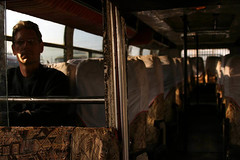
 We turn off the highway and find ourselves on an elevated, single lane brick track, more like a drainage dyke than a road, running through the countryside. With rice paddies on each side we bump along in a cloud of dust about 10 feet above the fields. Ironically, the bricks in the road we are following are yellow.


