
Taipei 101


Taipei 101
The architects and designers of Taipei 101, once the world’s tallest building (from 2004 – 2010, when the Dubai Burj was finished) took not only the physics of construction seriously, but also the metaphysics. They made sure that the 508 m (1667′) tower wouldn’t be brought down by a typhoon wind, or a 2,500 year earthquake event, or by the forces of bad fung shui. The “101” in it’s title, for instance, is significant for more than just the number of floors: it goes one up on perfection (100 + 1), and is the same forwards and backwards – an eternal number. To ensure stability, the structure is anchored on pylons sunk 50m into the bedrock – and there is no 44th floor. Four is an unlucky number, so two fours must be worse. Eight, however, (as in 500m + 8 tall) is especially good because it is the luckiest number (7) plus 1. Lots of math to absorb, and we haven’t even touched on the calculations of the bad-feng-shui deflecting fountain by the main entrance.

Bamboo or...
Whether the massive green glass structure looks like bamboo – the ultimate symbol of China and tensile strength – or a stack on take-away Chinese food boxes is yours to decide. What can’t be doubted is that it dominates the city skyline.
Our friend Helen grew up in Taipei and very generously suggested we stay at her mother’s apartment, which wasn’t currently in use. She also arranged for a car to meet us at the airport (most appreciated after 13 hrs. of flying and a 5:40 am arrival time) and take us there. We stayed in Taipei for 6 days, but many of the things we found to be typical of the city we experienced in the first 6 hours. 1) Things work. Whether it was Helen’s plan to get us to the apartment or the brilliant metro system, we were always whisked around efficiently. 2) The people are really friendly. Although she spoke little English, the aunt warmed our hearts

At the BBQ
showing us the apartment, and had a welcome pile of fruit on the table for us, as well as a (how did she know?) can of tonic. 3) There is food everywhere. We had dinner

street market
with Stewart, an old friend of Katheryn’s, and his wonderful partner Anna twice. Once at their place, and once at what Stewart described as a not-to-be-missed local experience – an all-you-can-eat meat BBQ. Fabulous, it must be said, and K got to pile up the Haagen-dazs for dessert. Most of our eating, however, was done in the night markets which spring up all over town, or in one of the multitude of local restaurants where a plate of rice and 5 toppings cost about $1.50.
Stewart, who has been working as a teacher and actor in Taiwan for 11 years, was also a great source of information about the city. Much of Taipei, he told us, was the result of the 50 year occupation of the island by the Japanese, which ended in

Japanese-era buildings
1944. The vast acres of low-rise buildings with the characteristic small square “bathroom tile” facades are from this era. Most of us know Taipei as the capital of a country called Taiwan. It’s more complicated than that. Officially, Taipei is still the provisional capital of China. The Republic of China (ROC) that is. The ROC was governed by Chiang Kai Shek and his Kuomintang (KMT) party from the fall of the last Qing Emperor in 1911 until 1949, when they were defeated by Mao’s Communists. Then the KMT fled to the island of Taiwan, forming a government-in-exile until their eventual return as the legitimate rulers of China. China (the People’s Republic, that is) has different views on the subject. Each one considers the other to be occupied territory, a source of endless tension for themselves and the world. A policy of deliberate ambiguity has become the

Sun yat-sen and friend
status quo, and a finely tuned ear for nuance has been developed on both sides. For instance, Taiwan is happy enough that it’s biggest backer, the US, officially “does not support” independence, rather than “oppose” it, as the Chinese wish. In the Olympics, Taiwanese athletes received medals for the fictitious country of “Chinese Taipei”, under a made-up flag while some song about the glorious Olympic committee played. Stewart, playing a role recently, had to say “Formosa”, rather than “Taiwan”, in case it upset China.
We knew we had to see the “National Museum” where much of the cultural heritage of China ended up, transported with the fleeing KMT, but we didn’t know there are at least 4 variations on the name. The one we wanted was the “National Palace

National Theatre
Museum” – and it was the 4th one we tried. It speaks to me about the depth of the refinement of a culture where for 4000 years some of their greatest art has been put into the production of “wine vessels” – decantors (albeit big bronze ones) by any other name.
Thanks in no small way to Helen and Keith in Vancouver who encouraged us to stop in a place we had only transited through, and who made the arrangements to make our stay easy and fun, and to Anna and Stewart for showing us around and being such interesting hosts, we loved Taipei. It’s not a tourist destination, which is one of the great things about it, and apart from the museums the only “site-seeing” we did was a large sprawling

Chinese cemetery
cemetery on a hill behind Helen’s place. It doesn’t have the flash and glitz of Hong Kong, or the polished languorousness of Singapore, or the bustle and charm of Bangkok, but I can see why it would be a tempting place to live, and we even talked about retail opportunities with Stewart. It was a great way to start our trip.
For more photos of Taipei go to the Flickr link via our web site: https://www.kebeandfast.com
or click on the link directly here: http://www.flickr.com

Bra salesman
/photos/croquet/sets/72157632020763267/
For the video experience, go to http://www.youtube.com/watch?v=yFYed31lghw&feature=share&list=UUzPNkH_3cH9Oz3q-g71UkUA
Signing off from the ROC, Your Foreign Devil Correspondents


 committee has to be consulted, and special permission given to go to the hospital. Although Bali is Hindu, and the observation of Nyepi is enforced by Hindus, there is certainly no equivalent in India: it seems impossible there could be one universally accepted moment of silence in that charged up country.
 alley, seem to consider huge breasts and pointy nipples especially fearsome.
 island, and they are taking their cooking seriously, pulverizing fresh spices into marinades and cooking soups, sauces and a whole chicken. A pair of Dutch ladies subsist on toast and mah jong, and a lone Spanish guy insists his soda crackers are all he wants, until the mounds of chicken and rice win him over. The biggest surprise on Nyepi, however, is the Balinese couple who have a small plot of land on the other side of a small canal, just opposite our patio. It is a relatively deserted place anyway, and the last thing we are expecting is to see someone there on Do Nothing Day. Yoga and his wife, unfortunately, spend all day scooping gravel from the canal for the foundation of a new building. They can’t be seen from the alley, so all day they labour on, even though the Nyepi police at one point warned us against moving a chair too loudly in the restaurant.
 glorious. From our balcony we look over the hibiscus and frangipani and bougainvillea in the garden, the jungle-lined bowl of terraced rice fields, the smaller volcano, Gunung Seraya, to the east coast and the sea.
 Riding back over the hills we get caught in the only rain we have had since we’ve been here, a soaking downpour that leaves brown rivers flowing over the road. There are still lots of motorbike riders out, but most of them have jackets or ponchos. We just get soaked. But it’s a good rain to get soaked by, tropical rain, and afterward the plants all rejoice and exhale simultaneously and the air is so rich we bathe in it as much as breathe it.

 swimming pool – that he has booked for us: that’s how easy this has become! However we have come a long way from Kathmandu, 46 hours of travel in 5 days, which leads us to the umbul-umbul.
 cloth maker. They are all 5 meters tall and will retail at our sales for $16. We are stocking the colours you see in the photo (for a bigger image double click it) although quite a few (we cleaned out Wayan’s stock) are in limited numbers. As a special offer* and if you order NOW they are on sale for 5 pieces for $60 or 10 for $100. Keep in mind how charming they would be at all those parties, weddings or special events coming up this summer. If you are interested, let us know by email: katheryn@kebeandfast.com and we will set aside your selection. When we are back in Canada in the middle of April, we will contact you about payment and delivery details.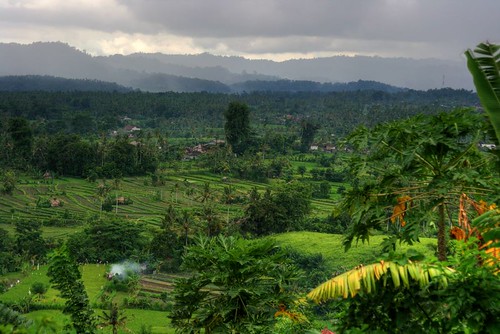
 throws, and taking the country down with it. People were rioting for food, atrocities were being committed against the Chinese and Christians (often the same thing; and often the scapegoats when things went bad), the Australian army was air-lifting their nationals out of the country, and the currency was close to being worthless. It was a traumatic time. A similar but bloodier scenario brought Suharto into power in 1965. I was only 4 at the time, but my family, who were living in Java, also had to flee the terrible circumstances. I went back in early 1982. At the time Kuta Beach was a quiet back-packer haunt, Legian was a separate village, and Ubud didn’t have any Italian restaurants. K had warned me it would
  be a shock to go back, so we have, over the years, left it off of our itinerary.
 that kind of power is.
 everything is made on Java. This is certainly true with the textiles, although we find many pieces from Sumba and Flores as well. We spend half a day in the cloth market in Denpasar, and are fortunate enough to meet Supriadi and his daughter Farhana. They are from Malang, in east Java, where I spent my childhood, and this connection is maybe why they give us the straight goods and the “harga bihasa’, the ‘real price’. We end up buying as many sarongs from them as we can carry on our bikes. Batik, of course, is an Indonesian word for the famous resist-dye process of applying wax to cloth. Although not a dead art, hand made batik is now mostly a high-end artisan-produced specialty. Most merchants will try to con you with either the very cheap “batik prints”- easily detectable because only one side has vibrant colour – or “machine batik”. These are actually true batik, except that the wax pattern application is done mechanically, and are impossible to distinguish from the hand made article- for me, anyway- except that each pattern is identical in every detail. In the end, the sourcing experience in Bali has made me appreciate even more the quality and the diversity of the hand-made culture in India.
 pared-down pack – which sits between my knees – on a short tour of the island. In fact everything is so beautiful we don’t end up going very far. The first stop is Ubud – a short jaunt inland – which has been a magnet for ex-pat artists since the ’30’s. Many foreigners have continued to settle here, and it is easy to see why. Ubud is built around a number of steep ravines and river valleys. Some of the most stylish
 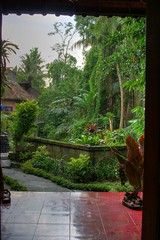 boutique hotels in Asia are built into the lush green slopes and we voyeuristically wander into some just to look around. The staff see through our grubby gear right away, but are always smiling and gracious. The great thing about Ubud is we can get a chi-chi room for economy rates. Peter shows us to a real gem: lovely gardens, a swimming pool, lotus pond, with our room individually set into the jungle above one of the rushing water courses – for $14! Again we curse ourselves for not budgeting more time here. It’s almost a blessing that for much of the next two days it rains torrentially in Ubud; we have to cosy up in our lovely room as the rain thunders and the thunder rolls.
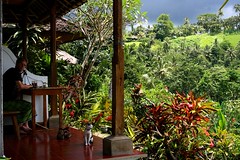 our guest house. Palm trees pose dramatically above a ridge of wild grass, patches of jungle foliage explode like green bombs frozen in time, and thick creepers try to blanket everything. The real eye-catcher though, is the elaborate rice terracing. The terraces transcribe every surface with an anarchic geometry, each patch a perfect shade of spring green. As if this wasn’t enough, people and nature have thrown extravagant colour into the mix. Frangipani and hibiscus and bougainvillea tumble from the garden in front of us; the butterflies are almost too much of a hyperbole to mention. A hummingbird with a long curved bill hovers for a second and nearly breaks my heart. Once you get over that there are the towers of clouds sailing
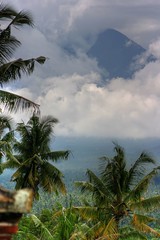
 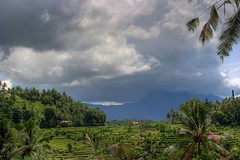 through the skies. They can be real drama queens, flouncing up their skirts, pouting black, giving mischievous glimpses of a huge volcano, and glamming it up for the carnival of sunset.
 long sarongs, and hopping through the thin, often muddy terraces, isn’t easy. As we get closer we see that, of course, there is an easier way, and on it are many men in traditional costumes and women carrying baskets of fruit and offerings on their heads. The Balinese love ceremonies, as one young man explained to us, not because they are necessarily deeply religious, but as much for the art and tradition. You could, in my opinion, make an arguement that there is very little difference.
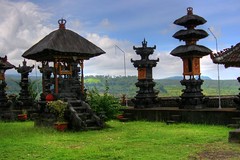 manicured landscape. The going is relatively easy, if a little indirect, and the worst thing is the over-protective dogs who always have to bark, and tell the next dog along the line that we are coming through. Eventually we reach the hill. For the first time that day, within sight of the temple, the paths vanish. The air is stagnant and the humidity is oppressive. For a couple hundred meters we are the suspicious focus of every dog in the valley, as we pull ourselves up the steep slope through thick elephant grass. The reward is a spectacular view – and of course, an obvious and easy way down. K. is enjoying dredging up some of her language skills unused for a decade, and jokes with locals that we pass.
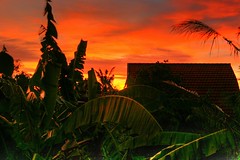 from here too soon.